Showing posts with label Long Beach Meditation. Show all posts

Thursday, February 23, 2012

The Joyful and the Worm

Last week, dear Lois of the Cross-Country-Save-The-Pets Odyssey invited me out of the blue to fly to the East Coast next month to celebrate her birthday and mine: if she paid my ticket, would I come? Well, wow!! Would I?!

But something new developed. On the one hand, pure joy at Lois' invitation; on the other, a gnawing, hollow, anxious feeling of "I don't deserve this." As luck would have it, that very same day three of us got together for a practice Voice Dialogue session. I was the last to be facilitated, and my pair of opposites were these two characters: the joyful and the worm. Both of them felt extraordinarily young. Both said they had been with me "forever." There was an interruption during my session, something Martha-Lou had warned us about as being potentially dangerous. I don't know about dangerous, but I did feel somehow split, half the mind tuned deeply inwards, the other listening to doors opening and closing and trying to identify sounds. I felt fragmented and it was a feeling that continued for some days. The presence of the two small children stayed with me: instead of sinking back to wherever they live, they were very much with me at all times, one on either side. I felt I was walking around with my arms around them. A weird feeling.

The next day, I saw HH. I told him about the invitation, my torn feelings and the Voice Dialogue. As a Gestalt therapist, he said, "Let's have them talk to each other here." I was alarmed: in Voice Dialogue the selves don't talk to each other. They don't even know another self exists. He said, rather grimly, "They'll talk with me." I insisted on having the center self present as well: in Voice Dialogue, center is the aware ego; I needed a home base, since both these two were exhausting. They appeared with no trouble at all. Cringing, clinging worm sat to my left, Happy Ali on the right. I sat between them and I could literally feel their presence, these small children, the one pressed up close to me, the other, trying so hard to be cocky and brave, but finally admitting, "I feel as if the sky is falling." I sat between them and mothered them, stroking the fabric of the couch (where I imagined they were sitting) with great tenderness. They cried through me, and I cried for them. As HH said, "All three of you are crying." It was quite a session. What it meant came much later.  I made HH tell me what had happened. He said, "You know what happened." I said, "I know - but she needs to hear it," nodding towards my right. So he addressed that little Ali who has tried so hard all these long years and who now sat there bewildered. What had she done wrong? HH was inspired: he told her, "You're still a part of her. You're not going anywhere. You're the one who can throw a party for forty people with no trouble; you're the one who can cheer people up by making them laugh. She can't do those things. Those things are your gift to her." She smiled then (does it sound mad to talk of 'she' in reference to myself?) and relaxed a little. I said to HH, "Do you remember when I first started coming here, you said I reminded you of the story of Atlas, holding the world on his shoulders? The similarity being that as a child I held my mother on my shoulders, my mother being my world? I feel now as if I have just set the world down. My hands feel so light." It was a cathartic moment. It wasn't that I had set down the burden of cheering up my mother. It was that I had set down the burden of being the Alison who needed to cheer up my mother.

That evening I hosted a meeting at my house. Only a few people from my little sub-committee could come so I had also invited the Advisory Committee. The AC is the committee that does the brunt of the work for Long Beach Meditation. Four people came. Three from my lot: one severely jet-lagged and sleep deprived, one in physical pain, one straight from a long day's work; and one lone member of the AC, up from the desert. Nobody else came from the AC. I was so angry that nobody showed up! Not only that, but nobody had even bothered to RSVP! I thought if THIS group of people can't be bothered to respond or show up, what does that say about the organization? My meeting had nothing to talk about without the others being there. I would have cancelled had I known they wouldn't show up. And so on and so on. Isn't it easy to slip into blame and anger? To get all spitty-faced and self-righteous because after all, look at me, doing the good thing, having my meeting and where were the rest of you... It hit me in the night. Who was it who was getting so bent out of shape? Yet another childish facet, dutiful, responsible, doing everything right according to her sights, in order to be accepted, win a few gold stars, get that pat on the head.

It was all so clear. Who is the one whose hand shoots up to volunteer for any old thing? Nothing is too much trouble, too much work or too time-consuming. And for what? To fill that nagging hole, to silence that wormy voice on the other side, the one that can only cry, "Not good enough!" If I am accepted by the group, better yet, if I make myself indispensable to the group, then I MUST be all right. And all of this chugs along unconsciously, as long as everything goes according to plan. When there's a glitch - when I throw a meeting to which nobody bothers to come, for example, and my reaction is a sort of self-justified muted rage - it becomes glaringly obvious that I have some other agenda going on, some need that isn't being met.

I've been doing this for a very long time. When Victor first invited me to be a member of the AC, my first and honest reaction was to say with a rueful laugh, "But I hate committees!" In the next breath, I hijacked myself with a speedy acceptance, so pleased was I to be a part of the inner sanctum. Thrilled to be chosen, because that must mean I was worth something.

So it has been a hard haul getting to this point two and a half years on. Who wants to admit to themselves that they are not half as good a person as they like to imagine they are? That they have been run for a lifetime by two little kids: one, the pleaser who knows so well how to make herself liked; the other, full of fear, holding all the negativity because the other, so much stronger and  forceful, will allow no part of it in her world.

My first thought was to disband my little committee; my second to detach from the AC. I feel that somehow these two little ones cannot be allowed to run the show anymore - no, 'allowed' is the wrong word. Poor things: they ran it because there was no-one to relieve them of the job. It had worked pretty well, after all - Happy Ali got me a good husband, a beautiful daughter, kind and generous friends, a life with enough leisure time to ponder all of the above. She had no idea that things were not as they appeared on the surface.

The thing is, knowing now what I know, I cannot continue as before. If there is an adult in this house, it is more than time for her to take charge and let those little ones rest. If things carry on as usual, what was the point of all the pain?
Me in my uniform, being cheerful.

Once upon a time, I decided crying served no purpose, sorrow changed nothing, and took a determinedly cheerful route. And at the time, I was absolutely right. I was a child without a voice and there was nothing to be done but make the best of it in the only way I knew how. To make myself be liked, to fit in, and the way to do that was to be happy because "Laugh and the world laughs with you, cry and you cry alone." My motto.  I find it interesting to realize that at boarding school, the place where I had no voice, I who was never sick, was sick at least once a term with tonsillitis. I lost my voice for real and as a result, I got to spend a few days in the Infirmary, being looked after as much as any of us were looked after, by the school nurse/nun. She was not in the least a cuddly nun, being the whitest, palest person I have ever seen, in a white habit yet, but she was a cool, competent grown-up, respected and capable, and I, who yearned to be looked after, at least felt safe if not loved with her.

A card I sent home when I was around 12. Pretty much sums up the way it was for six years of my life. In the picture marked 'change' I am changing my stockings and doing up my suspender, in case you're wondering what that black thing is.
Anyway. If I revert to things as before, then that little girl who had no voice way back then will continue to have no voice at 50 bloody 7. How can I, knowing what I know, go on as before? For all of the four previous Beginners' Courses, I have been there every Sunday from 1 to 5pm, doing the registration, the greeting, taking the form back at the end of the day, updating it on the computer, sending it off to the treasurer, printing it out for the following week. Even when my cousin was here on a once in a lifetime visit from Australia, at the same time as my beloved daughter was down from Berkeley, I made sure I took precious time to do that job. It was my DUTY.

I cannot think of anyone who would do that, everyone else seems to have such clear priorities. How did mine get so skewed? I cringe to remember an incident when Helen was in high school and I was teaching: she scarily fainted twice as we were getting ready to leave the house. I had never seen anyone faint before and it scared me to death. I called the paramedics and even though she had come around, they loaded her in the ambulance to take her to the hospital to find out what was wrong. I went back inside to get ready for school. Minutes passed and the doorbell rang. It was a fireman.

I was surprised they were still there. "Um. We're waiting for you. Are you ready?" he asked. "No, no. You go on ahead," I said, trusting them to do their job. Helen was safe. I had to get to school and arrange my classroom for a sub. THEN I would go to the hospital. When I got to school and told them in the Office what had happened, and the principal asked, "But where is Helen now?" "In the hospital," I said. They practically pushed me out the door to go to her. I remember being confused. Surely doing my DUTY - my teacher job - was more important than being a mommy?
Oh God.

The Oh God comes from this. From right this minute, realizing I have internalized both of my parents' opposing voices, only they are playing from an eerily childish perspective. This is how my priorities got skewed. A common scenario: My mother, shy, bookish, intellectual, hating the superficiality of diplomatic social life, suffering from ferocious migraines, begging my father to be allowed to stay home - or if they had to go to some such cocktail party, that he would promise that they would leave early. Dad, so English, so pragmatic, also sociable and charming, would say in disgust, "Pull yourself together, Maryse!" Showing a rare irritation in his voice, "How can we decide now to come home early? We might be having a lovely time. Why are you always so negative!" And she, with her pain and her migraine, like that was dismissed. She would deflate, literally sag, while he scolded her. She became invisible. And I, the quiet onlooker, Daddy's girl, must have determined in some dim corner of myself, that I would do my duty, I wouldn't let the side down - and there, plucky, cheerful, dutiful, all those things sprang into being to counteract my mother's perceived weakness. So that years and years later, I could abandon my teenage daughter in a screaming ambulance going to who knows where, as she was suffering from who knows what. And abandon her again (along with my cousin) to check in the Beginners' class. I wonder how many times I have abandoned her in this way? As many as my father abandoned my mother, I would imagine.

My volunteering to do it all was part of this 'isn't Alison wonderful' campaign being waged by the little girl. It worked too, didn't it? Except that the approval I was really seeking, my father's, my mother's - ah well, I will never get that, will I? In that last week before my Dad died, he told my sister that she was "the best daughter a man could wish for." I loitered around his bedside, hoping he would tell me I was also a pretty damn good daughter too, but he never said it. Words! He died in my arms, but he never said he loved me. I've been searching for my father's love my whole life. I only found that out today.

It is a terrific joke on the part of the Universe, a masterpiece of timing, that today happens to be the day that my self-appointed father/mother figure, poor long-suffering Victor, is signing the lease on a place in Ojai. Which means he will be dividing his time between Long Beach and Ojai, which is about two hours away. I imagine that he will spend more and more of his time in Ojai, leaving us here to get on with it. To the child - the whole bloody kindergarten in me - this is abandonment all over again, except instead of me being sent away to boarding school, Victor as parent is sending himself away. I thought I was okay with it, had become used to the idea, but for him to be signing the lease on this particular day, in this particular time period, seems especially significant.

In Voice Dialogue, every facilitation is designed to strengthen the aware ego. It is not a place one can live out of, apparently, although one can aspire to. My greatest fear is that here I am, deeply aware of the children who at last see a chance to lay their heads down and rest - and is the adult strong enough to pick up the reins? Am I strong enough? Brave enough? Aware enough? So many years of conditioning to work against. So much easier to say 'stuff it' and go back - only, I can't go back! I see creepy motives behind every little thing I say or do, and where once I thought I was wholly good, now I see how dependent I am on others' good opinion. Most of what I do has the aim of pleasing others. And if it's not forthcoming - look out! Krishnamurti asks if it is possible for us "to live with what we actually are, knowing ourselves to be dull, envious, fearful, believing we have tremendous affection when we have not, getting easily hurt, easily flattered and bored - can we live with all that, neither accepting it nor denying it, but just observing it without becoming morbid, depressed or elated?"

Can we live with all that? Can I? I have no idea. What happens now? I do know that my meditation practice has suddenly received an infusion of energy. Perhaps all that energy I was channeling elsewhere is now available for me to use for my own purposes. I have lost three pounds, after spending weeks and weeks on a gentle gain. I am positive that fat is an excellent defense, a way to feel safe, at least for me. I had a dream at the start of this period, that someone was pushing to get into the house and I was pushing on the door trying to keep them out. Trying to scream to my husband , "Unwelcome intruder!" but I had no voice. And whoever it was, pushing from the other side, was winning. Who was that out there? Was it that poor little disowned self, the little worm? No, it felt big, angry, powerful, but maybe it felt like that because I was so afraid of it. Woke up before I saw what it was, heart pounding, sweaty, nightmare symptoms. Perhaps there is simply something in me pushing to the surface that is saying "Enough! I won't be shut away in the dark any longer!"
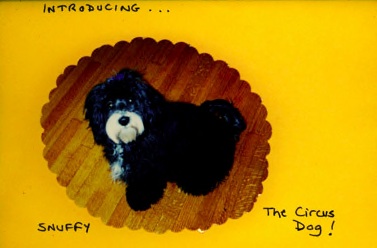
Snuffy, Spirit Guide aka Circus Dog

I've been crying a lot. Grieving my Snuffy, my little dog who had to be put down 18 months ago. He was twelve years old, but had been sick for five years with a chronic illness. Back in my twenties, I had a blind psychic friend who told me my spirit guide was a black dog. Somehow I imagined a big dog, like a labrador. A couple of days ago, it occurred to me it could have been a small black fluffy dog; my spirit guide could have been Snuffy. Made me cry. I have not cried for him until now, not once, always managing to say with great common sense, "Well, he was in such a bad way. It would have been one thing if he'd been run over, if he'd been young... but you wouldn't have wanted him to live a minute longer than he did, the way he was." Which are - come to think of it - exactly the same words I have used about my father, wasting away with cancer. I haven't cried for him either, once past the day he died.

Everything is related. Everything repeats, until we get it.

I don't think there is a darn thing I can do about any of it except remain open, inquire into everything and be honest with myself. And start saying no, or at least, "Can I get back to you on that?" That would be a start.

I have faith that it is ultimately good: I created a 'Beyond a Vision Board' just a few short weeks ago in my writing class; it's like a collage filled with images and words that appeal to you right where you are, not aiming at some future time. Mine is filled with images of mothers and children, prayer hands and water, and the words 'Open to Change with Heart' and 'You are You. Whole.'

Whoever that is.

My 'Beyond a Vision Board'
P.S. Writing all this out feels like an enormous weight has dropped away. I thought, if Lois rescinds her invitation, it won't matter, because I have learned so much that I would not have learned otherwise. Instead, today a long phone call followed a flurry of emails and together we booked my flights, made plans, became giddy with excitement. Pure joy and gratitude. No hidden worm.


Wednesday, December 7, 2011

Lessons Drawn from Workshop, Retreat, Thanksgiving/ Field Day, Death

I have been working on a blog for weeks now about a wonderful psycho-spiritual workshop called A Path with Heart that I attended. But I didn't get the words down quick enough and the following week I went on an All Day Silent Meditation Retreat and I wanted to include that because the workshop and the retreat seemed to go together, but this meant rewriting the workshop bit otherwise it would be too long (as if my blogs aren't long enough). Then life itself stepped in and gave what teachers call the 'culminating activity' of both workshop and retreat, the one that shows whether or not the student has learned the lesson. At which point I had to throw out everything already written, but then it was the long weekend of Thanksgiving and that was all about being with family and eating too much. The week after Thanksgiving, and I really did intend to get to the blog, only first I had to come up with a word game for a Field Day in my writing class ...

... detour to my writing class. It began life in a senior center, and the seniors so loved the teacher, they refused to let her go after her allotted number of weeks. That was a few years ago. The class has remained loyal and grown so that we have had to move to a larger venue in a church hall. While our teacher is barely 40, the rest of us are in our 50's, 60's, 70's. We even have an 84 year old, a lively woman with more energy than me most days, who has a paying job ("I'm their token senior") and inspires me no end. Actually all the ladies inspire me no end...

... and then I was back to the blog, all these good things to write about, one after another: Workshop, Retreat, Thanksgiving and Field Day - and then I came home last week from the Field Day to a terrible message on the answering machine and a new and tragic 'culminating activity': my husband's 28-year-old nephew had died in the night. No-one knew what had happened only that he wouldn't wake up. This the son of my husband's younger brother, who died suddenly of a heart attack two years ago. Too much sorrow! For the family, especially for his mother, his sister. For his grandfather, my husband's Dad, and his aunt, my husband's sister, who looked upon this boy as the son she never had.

All this is happening in Pennsylvania, on the other side of the country, in the big house in Bucks County where John's parents lived with his younger siblings, when we were married in 1978. There were six children; John is the second oldest. John's mother was the heart of the family, kindness itself. We spent every Sunday there in those early years, before we moved to California. In winter we'd go ice skating on the creek, or play Monopoly for hours with the younger brothers, while Mr Dad shouted at the football games on TV. Mrs Mom would provide hot chocolate with marshmallows, and all sorts of fattening treats throughout the day, as well as a blow-out dinner and heaping bowls of ice cream later on. This was the big easy uncomplicated family I had yearned for growing up. People with roots, who stayed put, who had built a house on land owned by a great grandfather. They were like a family out of a really good children's book.

Now the house is falling into disrepair, and only one of John's sisters remains with Mr Dad whom we now call Pop. Mrs Mom is dead, as are shockingly the two younger brothers. The nephew lived with them, grandfather and aunt, in a happy arrangement, three generations together. Now the survivors are reeling. Talking to Pop: "When you're 92 you think you've seen it all. And then this..."

How to put the pieces together? Workshop, Retreat, Thanksgiving/Field Day, Death... I've been trying to let it be. Trusting that the lesson will rise up. But being impatient to a fault, secretly worrying over the pieces like a jigsaw made of sky: you KNOW there's a pattern, you just can't see it. And then I received this quote by Malcolm Muggeridge in an email: "Every happening, great and small, is a parable whereby God speaks to us, and the art of life is to get the message." I believe that ours is not a random universe and that everyone's particular life is his or her own teacher. But sometimes the lessons are universal. If I didn't think that, I'd be writing all this in a diary. So here goes.

When I was first writing about Sasha's workshop, I was focused on myself and what I got out of it. But now as I have to keep working to fold each new event into my non-random universe, it's as though the camera has zoomed back to show the bigger picture. The lesson of the workshop was not simply about my own "core wound" - but more importantly, that we all have a core wound. It was about looking around that room at those strong women, and knowing - because each one 'fessed up - that every one of them has some deep buried hurt. Briefly, with the short-lived clarity of death, I saw us as the small children we once were, hiding behind our grown-up faces, doing the best we can.

The lesson of the All Day retreat was to slow down and fight against the robotic programming, the instant reaction, the thing inside us that is so quick to say "oh yes! this reminds me of that, this is that, therefore this is what we do next." No! Every situation is unique, just as every person is unique, and is changing moment by moment. Our wanting things to be this way, once and for all, is our attempt to control things that seem to make no sense. A 28 year old boy dying in his sleep makes no sense. My husband says, "28 is when I met you. My life up to that point was a bit of a disaster. It all turned around after 28. It began then." So there is deep sorrow that this boy will not have that same chance to make who knows what of his life. But even that thought is programming, is our clever minds, comparing and analyzing. Who can say about a person's life and judge it in any way?

For me, the immediate lesson to be drawn from that death, from all death, was simply this: to treat everyone in my life as if I could lose them tomorrow. Because one day I will. Either I go or they go. So at all times, make sure I am current with my friends, no smoldering resentments, nothing left unsaid, especially not the words of thanks or appreciation or love. We are all in this together, whistling past the graveyard, doing the best we can. Sometimes it is an act of supreme courage just to get out of bed in the morning. We need to recognize that in each other and be kind to one another. It is the very least we can do. It is about relentlessly living in the present, not carrying on grudges from long ago, but reaching out in dialogue, searching for truth always tempered by kindness. This was so obvious that first day. Less obvious now, when the pain the family is experiencing is so deep, it's hard not to get lost in it.

Since I heard this news, I have had an overwhelming urge to bake. I am not much of a cook, nor yet a baker, but this urge feels so right. I imagine a long long line of women stretching back into the mists of time, who when they hear some terrible news reach for the flour, the butter, the eggs. The instinctive urge to take measured heaps of raw ingredients, and by combining them just so, to create something sweet and nourishing out of one big mess. Sometimes you have to throw your hands up at the larger picture, which makes no sense from our limited view, but here in the smaller one, the one bound by a hot stove and mixing bowls and wooden spoons and cookie sheets, a tiny bit of goodness at least can prevail.

I think of my daughter and her friend, staying up till 4:30 in the morning on the day before Thanksgiving, baking pies, preparing the stuffing, putting in a huge amount of effort on their one day off just so we four could eat like kings. They had never cooked the traditional Thanksgiving feast before, and they wanted to do it right. They did, and the effort showed, and the whole thing was deeply touching in the way that things are, whenever people expend a enormous amount of energy on something that will not last. Acting as if it matters. According to the poet Linda McCarriston, it does matter. In a poem entitled "Thanksgiving," about why we bother with all the work of this big feast, she writes:

"Any deliberate leap into chaos, small or large,
with an intent to make order, matters."

There is something else of course. All this jumble of stuff happening, the good, the bad, the ugly, and me trying to capture it on paper and then having to rewrite it because more stuff happens and like a turn of the kaleidoscope, there's a whole new picture, and how to make sense of that? Then I realize this. That my attempt to write this experience is an attempt to nail Life itself down and squeeze it into a box. To proclaim "and then this happened" as if there were only one this. And by fixing it with words, hope that it would remain this forever more. Then I find myself getting all hot under the collar because stuff keeps happening. Life does not go on a coffee break while you jot down what's happened up to now. It barrels along, and just when you think you know the plot and how the story ends, it throws a curve ball. Besides the big events I mentioned, in the last month a cousin of mine died unexpectedly; a friend of a friend committed suicide; I baked three batches of oatmeal raisin cookies and gave most of them away but not before I gained five pounds; I wrote a rude parody of Jingle Bells that I thought was hilarious and nobody else did, and so on. What a funny collection of events! Where's the coherent plot? Life is change, and because we want things to stay put (but only the good things, thank you!), we suffer, just like the Buddha said.

This wanting it to make sense is once again the work of our clever minds, ceaselessly looking for patterns. It is what it does, after all. It is what it is programmed to do. Take a bunch of raw data, flip through the giant rolodex in our heads that contains all of our memories of books, plays, events, people, and so on, looking for matches and extrapolating from that situation to this. Good basic survival skills. But the moment I try to fix what has happened on paper and say it was like this, something happens to throw that earlier event into a different light. It wasn't that what I had written was no longer true, but it was no longer the whole truth. It was limited, like the five blind men describing the elephant according to what part of the elephant they happened to be touching. This is probably one big yawn to everyone out there, but for me, who has been such a believer in black and white thinking all my life, it is a revelation to see in my bones that there is no such thing. Truth is changing moment by moment. Our little selves, yearning for security, try to make it otherwise by creating elaborate stories and getting it down quick before we forget. But it's not that we forget - it's that things change and what was once true is no longer wholly true. Only we don't want to believe it because it makes life utterly precarious and begs the question, "Who are we?"

So what if it's much simpler than we think? What if this ceaseless change is simply the way life is, and our task is to learn to ride it like a surfer, without falling into the troughs and drowning? What if we are much simpler than we think? What if we are not our thoughts at all? Or as Krishnamurti would say, what if we are only thought? There's an unsettling thought.

And in that case, perhaps what matters is immersing ourselves in the little things, moment by moment, as if they matter - because after all, what else is there but this very moment? Can we hold a philosophy in our hands or touch an idea? Can we get our heads around The Meaning of Life and Death, in important capitals? Do we have any answers? Perhaps a more useful question is: Why do we need answers? Why isn't it enough to be alive? I keep coming back to the Field Day in my writing class. It involved word games which we, the students, invented, covering everything we had learned over the past several months. We worked hard at our games ("Define ephrastic poetry"), played them with gusto. We brought prizes and props and good things to eat. Like my girls staying up till 4:30 a.m. to cook us a Thanksgiving feast, it is important to pay attention to the effort that went into that Field Day, because the effort is all there is. Each of these women, carrying terrible stories of their own of heartbreak and loss, understand the importance of putting story aside, of showing up and making an effort. The moment I got home and heard the message about my nephew, I got it too, that what we had shared that morning was not just a fun time. It was the stuff of life.

Here's this about the Dalai Lama by Jeffrey Hopkins : "...when the Dalai Lama went to Europe for the first time, he would arrive in a city and announce, “Everyone wants happiness and doesn’t want suffering.” That's it, isn't it? What we have in common, animals, plants, human beings - all living things. So simple. So hard to grasp. I think it is brave to reach out to others, brave to make an effort, brave to enter cheerfully into the spirit of things, in a world where change, if not outright tragedy, can and does strike when you least expect it. I wrote to the writing class almost as soon as I heard the awful news:

"I wish I could hold each of your faces and tell you how dear you are to me. How touched I am for the effort that everyone put in to our Field Day. Ribbons and prizes and special paper and forfeits and so many good things to eat. I'm only sorry it takes a shock like death to wake us up and appreciate every single moment we're alive."

Me telling my Helen how dear she is
Whoever you are, reading this, I wish I could hold each of your faces too and tell you how dear you are, just for being alive.

I wrote this shortly after my nephew's death and meant it with all my heart. But time has passed (not even ten days!) and I am no longer that open and vulnerable. Now I just wish I were that good. And wonder sadly what it all means. And know that in a week I will read this and wonder what I was trying to say and why don't I feel it any longer - proving my very point that everything changes and nothing remains the same. Including this person I think is me.

All Day Silent Meditation Retreat

 I have been to so many of Long Beach Meditation's silent retreats in the past two years, I forget how daunting it was in the beginning, to sit and walk and eat mindfully and in complete silence for hours on end. Now I welcome the silence. I am such a busybody normally, as if someone appointed me Official Helper and my role is to be ever vigilant, leaping to the rescue - never mind whether the person wants to be saved or not. As Victor wrote to me, "But when one jumps in to "save" someone, who are they really trying to save.  So many times, we just cannot stand the pain someone else's suffering causes us.  It is like the story of the butterfly emerging from it chrysalis - if you try to help it, you injure it permanently." I understood then that I am eternally trying to save my mother, who suffered more than anyone I knew, and since I failed to "save" her, I keep trying (unconsciously) with others, and of course that doesn't work so well either. What it does do is reinforce those feelings of 'not good enough.' The past once more reaching out a ghostly hand to stir the pot of the unthinking present.

Zeeba in a box
We did discuss this, HH, my therapist and teacher of a different ilk, and I, the day before the retreat. I told him all about Sasha's workshop and the uncovering of 'not good enough' and all its sad consequences. He gave me homework, something to consider over the next fortnight: "Do I matter if I am not being helpful or cheering people up, and if so, how?" Good question. How do any of us earn our place in the world - and why must it even be earned? It is something that so strikes me with animals: my cat who balances on my shoulder, leans down and gently closes my nostril with her paw to wake me up in the morning, makes her demands known as a matter of course, and trusts that the people in her universe will provide. Such huge trust our pets show us, that of course they have a right to jump all over things and act as if they own the place and we will look after them just because. How did we lose that same sense of belonging? I suppose because our universe, unlike our pets', is unstructured and unsafe - anything can happen at any time. Of course that is also true in our pets' world too - there are earthquakes and house fires and accidents that we can't prevent - but the illusion is that we can keep these creatures entrusted to us safe, and since they don't know any better, they play along so we can all feel safe, at least until it inevitably comes crashing down. We put our pets in a box of our own design, and take care of them perhaps as we secretly wish someone would take care of us.

So the first thing on Saturday at the retreat was to bring the focus out of the head, out of thinking mind and into the present. The effort involved makes it abundantly clear, at least to me, that control is an illusion. It is enormously difficult to keep the attention on what is happening moment by moment. Victor described our minds as computers, whose job it is to learn a procedure as quickly as possible so that it becomes automatic. Obviously a useful survival skill. But now, the effect of that hard-won automaticity is that we rarely look out at the world with new eyes; everything is filtered through the totality of our experiences to date: from the general - gender, nationality, religion - to the specific - our upbringing, childhood, schools attended - to the minutiae of any given moment - hunger, fatigue, even the bloody weather. An overcast day gives rise to a completely different state of mind than a bright sunny one.
So we slow everything down in a retreat in order to look closely at the robotic programming and break the pattern. This is especially apparent in walking meditation. Since it is so difficult to sustain concentration (and I'm talking the sort of concentration that causes you to break out in a sweat), Victor suggested trying to hold the attention for short intervals - maybe five minutes at most - and concentrating on walking, by slowly, slowly raising the foot, lifting it in the air, moving it forward, setting it down. He demonstrated what this looked like. His movements were incredibly slow, the minutest increments, aware every second what was happening in the body. Meditators in other traditions tend to laugh at Vipassana meditators for creeping about like robots, but in fact what is happening in the mind is anything but robotic. That's the whole point. To be aware of the tiniest sensation throughout the body, as it engages in something as ordinary as walking.

Walking meditation
In the second walking meditation (having already zipped far too quickly through the first, intent on the restroom and a cup of coffee, nothing mindful about any of that except to hurry up before the bell signaled time was up), with Victor's challenge fresh in mind, I happened to stand up on my zabuton, the larger cushion upon which my meditation cushion was perched, rather than the floor itself. Some of our zabutons are a heavy foam rectangle but this one was more like a pillow shaped like a square, stuffed with down. Because it is uneven, it proved to be extraordinarily difficult to stand and walk on mindfully. I tried closing my eyes and almost fell over. Lifting one foot in tiny increments was easy - any larger movement done as slowly and I would have toppled for sure.

I felt like a baby learning to walk, weight listing from side to side, trying to find a centered place of balance. That moment when the foot absolutely must leave the ground felt as perilous as jumping out of an airplane not knowing if your parachute will open. I had to fight the urge not to get down on hands and knees and scuttle to safety. So creeping in this manner off my zabuton and over to the door of the hall on two wobbly legs took an intense amount of time. I barely made it to the door when the bell rang and it was time to turn around and creep right back again. Seated once more on the cushion, it was interesting to transfer that same level of concentration to keeping the mind on the belly breathing. At one point I could feel myself flush with the heat of the effort and my scalp prickle with sweat. Of course the moment I was aware of it ("Oh look! I'm concentrating so hard I'm sweating!"), it stopped. And I was reminded of Victor's analogy of the mind when it stills being like a forest pool, and all the little critters feeling safe enough to come out and show their faces. Some of the critters are so skittish, they dive back into the undergrowth the second they have been noticed. Who knew sweat could be skittish.

The day continued to unfold in its untethered way. One of the best things about a retreat is the putting down of the paraphernalia of time. One person is the designated bell ringer and rings a small handbell to signal a return to our seats. For the rest of us, we are able to let go the whole concept. Like not speaking, not watching the clock is tremendously liberating. A whole day in which to do nothing but watch your mind and get to know it a little better. If last week's workshop was all about what Sasha termed the 'descending' (psychological) work, this silent meditation retreat was all about the 'ascending' (spiritual) work. I realized they are two halves of the same coin and must be done together. To do the psychological without being grounded in meditation and the body keeps the work too much in the head, at the level of thought; to do the spiritual work without the corresponding psychological work can become a New-Agey exercise in spiritual bypassing (meaning you sweep the messy emotions under the rug because all is now supposed to be sweetness and light). Pema Chodrun writes:

"... it is helpful to understand that meditation is not just about feeling good. To think this is why we meditate is to set ourselves up for failure. We'll assume we are doing it wrong almost every time we sit down: even the most settled meditator experiences psychological and physical pain. Meditation takes us just as we are, with our confusion and our sanity. This complete acceptance of ourselves as we are is called maitri, or unconditional friendliness, a simple direct relationship with the way we are."

This was the aim of both weekends, to begin to establish that "simple direct relationship with the way we are." Workshop and retreat demanded an honest exploration of self: the one through inquiry into body sensations uncovering deep emotions, the other through sensation in the body developing concentration and mindfulness. Neither had anything to do with thought.

                    ******************************************************

I wrote a poem after an All Day Retreat, in January 2010. I understand what I wrote a whole lot better now, and for sure it is much harder than I imagined then! But here it is - it does capture a little of the spirit of the thing.


Singular Heart  by Alison Cameron

The beautiful quote that inspired the poem:
“The wise enshrine the miraculous bones of the ancients within
themselves.”

We converge in the early morning,
singular minds and sturdy bodies
settling on our separate mats,
clutching our complicated stories,
social smiles pasted on wary faces.
We shield our battered hearts and
hide our collective eye.

As watery sun inches across pellucid sky
we sit and walk
and walk and sit
with measured step and even breath
training monkey mind.

Slowly, imperceptibly,
the marrow of our ancestors
infuses our bones as
we show our soft underbelly
stretched out like the dead.

Trust, says our Teacher,
Turn the Light within.

Sitting tall at close of day
the barking dog is still.
The sweet song
of a singular bird
calls out with her small clear voice.
As if in response,
our singular selves rise up and merge
to fill the room with one singular mind
thrumming like a tuning fork
to the communion of sorrow shared in our silent world.
Our light shines -
no, blinds -
through the cracks in our vulnerable hearts.

I am undone.