Showing posts with label Farnborough Hill. Show all posts

Thursday, February 23, 2012

The Joyful and the Worm

Last week, dear Lois of the Cross-Country-Save-The-Pets Odyssey invited me out of the blue to fly to the East Coast next month to celebrate her birthday and mine: if she paid my ticket, would I come? Well, wow!! Would I?!

But something new developed. On the one hand, pure joy at Lois' invitation; on the other, a gnawing, hollow, anxious feeling of "I don't deserve this." As luck would have it, that very same day three of us got together for a practice Voice Dialogue session. I was the last to be facilitated, and my pair of opposites were these two characters: the joyful and the worm. Both of them felt extraordinarily young. Both said they had been with me "forever." There was an interruption during my session, something Martha-Lou had warned us about as being potentially dangerous. I don't know about dangerous, but I did feel somehow split, half the mind tuned deeply inwards, the other listening to doors opening and closing and trying to identify sounds. I felt fragmented and it was a feeling that continued for some days. The presence of the two small children stayed with me: instead of sinking back to wherever they live, they were very much with me at all times, one on either side. I felt I was walking around with my arms around them. A weird feeling.

The next day, I saw HH. I told him about the invitation, my torn feelings and the Voice Dialogue. As a Gestalt therapist, he said, "Let's have them talk to each other here." I was alarmed: in Voice Dialogue the selves don't talk to each other. They don't even know another self exists. He said, rather grimly, "They'll talk with me." I insisted on having the center self present as well: in Voice Dialogue, center is the aware ego; I needed a home base, since both these two were exhausting. They appeared with no trouble at all. Cringing, clinging worm sat to my left, Happy Ali on the right. I sat between them and I could literally feel their presence, these small children, the one pressed up close to me, the other, trying so hard to be cocky and brave, but finally admitting, "I feel as if the sky is falling." I sat between them and mothered them, stroking the fabric of the couch (where I imagined they were sitting) with great tenderness. They cried through me, and I cried for them. As HH said, "All three of you are crying." It was quite a session. What it meant came much later.  I made HH tell me what had happened. He said, "You know what happened." I said, "I know - but she needs to hear it," nodding towards my right. So he addressed that little Ali who has tried so hard all these long years and who now sat there bewildered. What had she done wrong? HH was inspired: he told her, "You're still a part of her. You're not going anywhere. You're the one who can throw a party for forty people with no trouble; you're the one who can cheer people up by making them laugh. She can't do those things. Those things are your gift to her." She smiled then (does it sound mad to talk of 'she' in reference to myself?) and relaxed a little. I said to HH, "Do you remember when I first started coming here, you said I reminded you of the story of Atlas, holding the world on his shoulders? The similarity being that as a child I held my mother on my shoulders, my mother being my world? I feel now as if I have just set the world down. My hands feel so light." It was a cathartic moment. It wasn't that I had set down the burden of cheering up my mother. It was that I had set down the burden of being the Alison who needed to cheer up my mother.

That evening I hosted a meeting at my house. Only a few people from my little sub-committee could come so I had also invited the Advisory Committee. The AC is the committee that does the brunt of the work for Long Beach Meditation. Four people came. Three from my lot: one severely jet-lagged and sleep deprived, one in physical pain, one straight from a long day's work; and one lone member of the AC, up from the desert. Nobody else came from the AC. I was so angry that nobody showed up! Not only that, but nobody had even bothered to RSVP! I thought if THIS group of people can't be bothered to respond or show up, what does that say about the organization? My meeting had nothing to talk about without the others being there. I would have cancelled had I known they wouldn't show up. And so on and so on. Isn't it easy to slip into blame and anger? To get all spitty-faced and self-righteous because after all, look at me, doing the good thing, having my meeting and where were the rest of you... It hit me in the night. Who was it who was getting so bent out of shape? Yet another childish facet, dutiful, responsible, doing everything right according to her sights, in order to be accepted, win a few gold stars, get that pat on the head.

It was all so clear. Who is the one whose hand shoots up to volunteer for any old thing? Nothing is too much trouble, too much work or too time-consuming. And for what? To fill that nagging hole, to silence that wormy voice on the other side, the one that can only cry, "Not good enough!" If I am accepted by the group, better yet, if I make myself indispensable to the group, then I MUST be all right. And all of this chugs along unconsciously, as long as everything goes according to plan. When there's a glitch - when I throw a meeting to which nobody bothers to come, for example, and my reaction is a sort of self-justified muted rage - it becomes glaringly obvious that I have some other agenda going on, some need that isn't being met.

I've been doing this for a very long time. When Victor first invited me to be a member of the AC, my first and honest reaction was to say with a rueful laugh, "But I hate committees!" In the next breath, I hijacked myself with a speedy acceptance, so pleased was I to be a part of the inner sanctum. Thrilled to be chosen, because that must mean I was worth something.

So it has been a hard haul getting to this point two and a half years on. Who wants to admit to themselves that they are not half as good a person as they like to imagine they are? That they have been run for a lifetime by two little kids: one, the pleaser who knows so well how to make herself liked; the other, full of fear, holding all the negativity because the other, so much stronger and  forceful, will allow no part of it in her world.

My first thought was to disband my little committee; my second to detach from the AC. I feel that somehow these two little ones cannot be allowed to run the show anymore - no, 'allowed' is the wrong word. Poor things: they ran it because there was no-one to relieve them of the job. It had worked pretty well, after all - Happy Ali got me a good husband, a beautiful daughter, kind and generous friends, a life with enough leisure time to ponder all of the above. She had no idea that things were not as they appeared on the surface.

The thing is, knowing now what I know, I cannot continue as before. If there is an adult in this house, it is more than time for her to take charge and let those little ones rest. If things carry on as usual, what was the point of all the pain?
Me in my uniform, being cheerful.

Once upon a time, I decided crying served no purpose, sorrow changed nothing, and took a determinedly cheerful route. And at the time, I was absolutely right. I was a child without a voice and there was nothing to be done but make the best of it in the only way I knew how. To make myself be liked, to fit in, and the way to do that was to be happy because "Laugh and the world laughs with you, cry and you cry alone." My motto.  I find it interesting to realize that at boarding school, the place where I had no voice, I who was never sick, was sick at least once a term with tonsillitis. I lost my voice for real and as a result, I got to spend a few days in the Infirmary, being looked after as much as any of us were looked after, by the school nurse/nun. She was not in the least a cuddly nun, being the whitest, palest person I have ever seen, in a white habit yet, but she was a cool, competent grown-up, respected and capable, and I, who yearned to be looked after, at least felt safe if not loved with her.

A card I sent home when I was around 12. Pretty much sums up the way it was for six years of my life. In the picture marked 'change' I am changing my stockings and doing up my suspender, in case you're wondering what that black thing is.
Anyway. If I revert to things as before, then that little girl who had no voice way back then will continue to have no voice at 50 bloody 7. How can I, knowing what I know, go on as before? For all of the four previous Beginners' Courses, I have been there every Sunday from 1 to 5pm, doing the registration, the greeting, taking the form back at the end of the day, updating it on the computer, sending it off to the treasurer, printing it out for the following week. Even when my cousin was here on a once in a lifetime visit from Australia, at the same time as my beloved daughter was down from Berkeley, I made sure I took precious time to do that job. It was my DUTY.

I cannot think of anyone who would do that, everyone else seems to have such clear priorities. How did mine get so skewed? I cringe to remember an incident when Helen was in high school and I was teaching: she scarily fainted twice as we were getting ready to leave the house. I had never seen anyone faint before and it scared me to death. I called the paramedics and even though she had come around, they loaded her in the ambulance to take her to the hospital to find out what was wrong. I went back inside to get ready for school. Minutes passed and the doorbell rang. It was a fireman.

I was surprised they were still there. "Um. We're waiting for you. Are you ready?" he asked. "No, no. You go on ahead," I said, trusting them to do their job. Helen was safe. I had to get to school and arrange my classroom for a sub. THEN I would go to the hospital. When I got to school and told them in the Office what had happened, and the principal asked, "But where is Helen now?" "In the hospital," I said. They practically pushed me out the door to go to her. I remember being confused. Surely doing my DUTY - my teacher job - was more important than being a mommy?
Oh God.

The Oh God comes from this. From right this minute, realizing I have internalized both of my parents' opposing voices, only they are playing from an eerily childish perspective. This is how my priorities got skewed. A common scenario: My mother, shy, bookish, intellectual, hating the superficiality of diplomatic social life, suffering from ferocious migraines, begging my father to be allowed to stay home - or if they had to go to some such cocktail party, that he would promise that they would leave early. Dad, so English, so pragmatic, also sociable and charming, would say in disgust, "Pull yourself together, Maryse!" Showing a rare irritation in his voice, "How can we decide now to come home early? We might be having a lovely time. Why are you always so negative!" And she, with her pain and her migraine, like that was dismissed. She would deflate, literally sag, while he scolded her. She became invisible. And I, the quiet onlooker, Daddy's girl, must have determined in some dim corner of myself, that I would do my duty, I wouldn't let the side down - and there, plucky, cheerful, dutiful, all those things sprang into being to counteract my mother's perceived weakness. So that years and years later, I could abandon my teenage daughter in a screaming ambulance going to who knows where, as she was suffering from who knows what. And abandon her again (along with my cousin) to check in the Beginners' class. I wonder how many times I have abandoned her in this way? As many as my father abandoned my mother, I would imagine.

My volunteering to do it all was part of this 'isn't Alison wonderful' campaign being waged by the little girl. It worked too, didn't it? Except that the approval I was really seeking, my father's, my mother's - ah well, I will never get that, will I? In that last week before my Dad died, he told my sister that she was "the best daughter a man could wish for." I loitered around his bedside, hoping he would tell me I was also a pretty damn good daughter too, but he never said it. Words! He died in my arms, but he never said he loved me. I've been searching for my father's love my whole life. I only found that out today.

It is a terrific joke on the part of the Universe, a masterpiece of timing, that today happens to be the day that my self-appointed father/mother figure, poor long-suffering Victor, is signing the lease on a place in Ojai. Which means he will be dividing his time between Long Beach and Ojai, which is about two hours away. I imagine that he will spend more and more of his time in Ojai, leaving us here to get on with it. To the child - the whole bloody kindergarten in me - this is abandonment all over again, except instead of me being sent away to boarding school, Victor as parent is sending himself away. I thought I was okay with it, had become used to the idea, but for him to be signing the lease on this particular day, in this particular time period, seems especially significant.

In Voice Dialogue, every facilitation is designed to strengthen the aware ego. It is not a place one can live out of, apparently, although one can aspire to. My greatest fear is that here I am, deeply aware of the children who at last see a chance to lay their heads down and rest - and is the adult strong enough to pick up the reins? Am I strong enough? Brave enough? Aware enough? So many years of conditioning to work against. So much easier to say 'stuff it' and go back - only, I can't go back! I see creepy motives behind every little thing I say or do, and where once I thought I was wholly good, now I see how dependent I am on others' good opinion. Most of what I do has the aim of pleasing others. And if it's not forthcoming - look out! Krishnamurti asks if it is possible for us "to live with what we actually are, knowing ourselves to be dull, envious, fearful, believing we have tremendous affection when we have not, getting easily hurt, easily flattered and bored - can we live with all that, neither accepting it nor denying it, but just observing it without becoming morbid, depressed or elated?"

Can we live with all that? Can I? I have no idea. What happens now? I do know that my meditation practice has suddenly received an infusion of energy. Perhaps all that energy I was channeling elsewhere is now available for me to use for my own purposes. I have lost three pounds, after spending weeks and weeks on a gentle gain. I am positive that fat is an excellent defense, a way to feel safe, at least for me. I had a dream at the start of this period, that someone was pushing to get into the house and I was pushing on the door trying to keep them out. Trying to scream to my husband , "Unwelcome intruder!" but I had no voice. And whoever it was, pushing from the other side, was winning. Who was that out there? Was it that poor little disowned self, the little worm? No, it felt big, angry, powerful, but maybe it felt like that because I was so afraid of it. Woke up before I saw what it was, heart pounding, sweaty, nightmare symptoms. Perhaps there is simply something in me pushing to the surface that is saying "Enough! I won't be shut away in the dark any longer!"
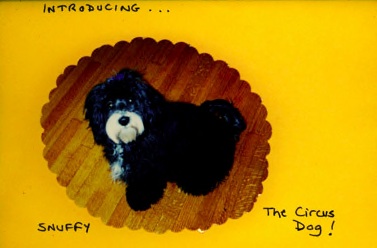
Snuffy, Spirit Guide aka Circus Dog

I've been crying a lot. Grieving my Snuffy, my little dog who had to be put down 18 months ago. He was twelve years old, but had been sick for five years with a chronic illness. Back in my twenties, I had a blind psychic friend who told me my spirit guide was a black dog. Somehow I imagined a big dog, like a labrador. A couple of days ago, it occurred to me it could have been a small black fluffy dog; my spirit guide could have been Snuffy. Made me cry. I have not cried for him until now, not once, always managing to say with great common sense, "Well, he was in such a bad way. It would have been one thing if he'd been run over, if he'd been young... but you wouldn't have wanted him to live a minute longer than he did, the way he was." Which are - come to think of it - exactly the same words I have used about my father, wasting away with cancer. I haven't cried for him either, once past the day he died.

Everything is related. Everything repeats, until we get it.

I don't think there is a darn thing I can do about any of it except remain open, inquire into everything and be honest with myself. And start saying no, or at least, "Can I get back to you on that?" That would be a start.

I have faith that it is ultimately good: I created a 'Beyond a Vision Board' just a few short weeks ago in my writing class; it's like a collage filled with images and words that appeal to you right where you are, not aiming at some future time. Mine is filled with images of mothers and children, prayer hands and water, and the words 'Open to Change with Heart' and 'You are You. Whole.'

Whoever that is.

My 'Beyond a Vision Board'
P.S. Writing all this out feels like an enormous weight has dropped away. I thought, if Lois rescinds her invitation, it won't matter, because I have learned so much that I would not have learned otherwise. Instead, today a long phone call followed a flurry of emails and together we booked my flights, made plans, became giddy with excitement. Pure joy and gratitude. No hidden worm.


Monday, January 17, 2011

Marching into Retreat: Called to Ten Days of Silence


By the time you read this, I will be launching myself on a new adventure. Not a Lucy-and-Ethel one like traveling across country on the spur of the moment to save aging pets who are not mine; this adventure ranks as the most difficult thing I have ever done. I'm leaving Wednesday for a ten day meditation retreat at the California Vipassana Center. This is a silent retreat: no talking, no eye contact, no reading, no writing. No dinner! Nothing to do but focus on the breath and sit with the contents of my mind for ten (long) days. 


[If you're interested, check out the Introduction to the Technique which explains it all: http://www.dhamma.org/en/code.shtml].


"But why are you doing this to yourself?" demanded the oldest member of my writing class. She's managed her 84 years by telling herself what's past is past and moving on. "You're the happiest person I've ever met!"


I thought I was the happiest person I'd ever met too. Then I started meditation. At the start, meditation was very calming, very relaxing. But as Chogyam Trungpa writes in "The Myth of Freedom": "Meditation is not a matter of trying to achieve ecstasy, spiritual bliss or tranquillity, nor is it attempting to become a better person. It is simply the creation of a space in which we are able to expose and undo our neurotic games, our self-deceptions, our hidden fears and hopes. ... Meditation practice brings our neuroses to the surface rather than hiding them at the bottom of our minds."


My "neuroses" didn't surface right away, they were far too well buried to get stirred up during a weekly thirty minute sit. They needed time. They got time on my first three day retreat a year and a half ago. And suddenly happy, helpful Alison discovered she was not nearly so happy or helpful - or so good - as she thought she was. After enduring several months of wrenching insights, I took myself to a therapist. I am English enough that that admission makes me squirm. In England, it is still considered a sign of weakness to seek psychological help. I suppose if it were as acceptable as it is here in the States, therapists would be overrun with people my age finally getting to grips with their boarding school baggage. Back in the '60's, sending your child to boarding school was a source of pride, a mark of success: who knew it would leave such scars?


Up until five years ago, I swore I loved boarding school. After all, there were midnight feasts and masses of friends and didn't we learn to be independent? And then I sat on a plane and my seat mate turned out to be a soul mate; we plunged deep into Alzheimers and life and love and death on a ten hour flight from L.A. to London. I never did find out her name. But somewhere over Iceland she said, "I've never met anyone who went to boarding school who didn't suffer from abandonment issues." I scoffed. "Not me!"


Years later I sat on my cushion and discovered: yes, me. I started to unpack the shadow bag that Robert Bly talks about, the one with all the stuff you can't bear to think about, the one that's two miles long by the time you're twenty. So why dig into this mess at all? Because it is affecting me in the present. I see how old patterns and triggers from when I was so very young are still setting me off at 56. Sometimes I feel as though I am at that point in the epic journey (or the reality TV show) where the hero is crushed, tearful, not sure what will happen next. But too late to back out now. Since the process, once started, seems to go on whether or not I actively participate, I thought it best to meet it head on. Hence the retreat.


Farnborough Hill, my old Catholic convent boarding school, continues to crop up. I found this passage in a book online, called "Recollections of the Empress EugĂ©nie" by Augustin Filon (written around 1873, book published in 1920). Reading it, I thought gosh, the place made the heart sink even when it was fairly new.

Farnborough Hill in 1881
"The Empress has invested the residence, both inside and outside, with her own personality and one can best describe Farnborough Hill as a mansion in mourning. A mist rises from the woods and envelopes the landscape in a veil which never disappears even in the brightest days of summer. The mansion stands on a hill, bordered by tall trees, and dominates the melancholy country which it overlooks. The stranger who approaches it must, I imagine, surely feel that Farnborough shelters a great life, which has been sorely wounded by the terrible blows of Fate and is here slowly awaiting the end. 


When one first enters the house the vague melancholy of the exterior defines itself as one wanders down the deserted, dimly-lit galleries where every sound of foot-falls and of voices acquires a peculiar emphasis. The walls are hung with innumerable works of art which recall a great artist or some cherished memory. The house constitutes an incomparable record of history, and in the evening, when a single ray of electric light leaves the spectator in shadow and sheds its white radiance over pictures and statues, a vanished world springs again into life, peopled with those once well-known figures who are the real inhabitants of the dwelling, and when the Empress passes in the midst of them one is almost tempted to believe that she, too, is a shadow of the Past." 


I hauled out the suitcase of my old letters home again, looking for a record of certain pivotal moments. It was disturbing to go through bundles of letters, the weight of all those words shoring up the little self while saying nothing important at all. The beginnings of it there at age eleven, a weekly scaffold, an edifice of unreality. Everything that mattered left unsaid, lost in the spaces, the blanks on the page. Everything unpleasant put out of mind. If I don't write it, it never happened. Those times when Sue wouldn't talk to me? They got a line: "Sue and I had a bit of a quarrel, I don't know what it was about, but it's over now, thank goodness." That was as much as I ever shared. 


Here's a nun story that blows most other nun stories out of the water: 
The nuns had devised a special last resort punishment for talking after lights out. The talkers were roused from their beds into dressing gowns and slippers. They were sent down the massive staircase, normally off-limits, to the Lower Gallery. Antique high backed chairs with faded brocade seats were spaced the length of the Gallery. There the chastened talkers sat, feet dangling in fuzzy slippers, until they were allowed to return to bed.


The Staircase
I was terrified at the idea of this punishment. We all were. So of course one night it happened to me. Big deal, you say. A time-out downstairs? Where's the hardship? Well, let me tell you about the Lower Gallery in that "mansion in mourning." I was placed on the chair at the foot of the stairs. Directly in front of me were three steps down to the forbidding front door, a huge wooden affair, with bolts and iron bits, like the entrance to a dungeon. To the left the Lower Gallery extended to the Refectory. Floor to ceiling windows ran along the left side wall, moonlight playing on a huge tapestry embroidered by the Empress Eugenie herself. She died before she could finish it and rumor had it that on the anniversary of her death she would add another stitch.
The Statue


Since no-one knew exactly when she died, the Lower Gallery was a place of fear after dark. Fear that escalated to heart-stopping dread if I turned my head to the right and caught a glimpse of Jesus in the wall of mirrors. The library door was concealed in the mirrors. In front of them was a tall statue of the Sacred Heart of Jesus - the one where he's holding his robe open to reveal his red heart. A votive candle perpetually burned at his feet and lit up his face eerily from below. And then all those mirrors reflecting the length of the corridor, the windows and the moonlight flooding the tapestry. Not to mention my own little white face and sad sack shapes of my fellow sinners. I didn't dare turn my head right or left. Straight ahead was the dungeon door. The very worst thing was behind me. Under the stairs was a sizable space. I glanced back to check it out. And saw ghostly, empty - wheelchairs! I sat barely breathing, clutching my stuffed dog Basil, until we were told we could climb the stairs and go back to bed. It was a punishment that worked. I never got caught again. Was it mentioned in my letters home? Of course not. 

The 11 year old in me loves this story. I relish it. It's so awful! I have told it so many times, though, I'm just playing with the words. The original terror has long mutated to anecdote - until in the course of sitting with it, a deeper understanding arose of what that story meant. It illustrates how profoundly unsafe were the adults charged with our care. At least that was my perception and it had enormous repercussions later in my life. 

I focused on Sue's "silent treatment" in my last blog as an example of my poor suffering little girl. I remember trailing Sue, walking three steps behind like a subservient wife, head bowed, between jeering schoolgirls, "There goes Sue's shadow, Sue's puppet...." I could no more have not followed her than flown to the moon. She was all I had and sooner or later she would talk to me again. If I could have pasted myself to her side, I would have. There was no such thing as too much togetherness, as far as I was concerned.

The school today - virtually unchanged!
But there was more to it, I found out sitting on my cushion. I had stopped short, focusing on my own mistreatment. Dwelt quite lovingly on it. I had never widened the lens to consider what happened to Sue. Because in the end, for all that I was so hurt, I was the one who abandoned her. In June of that first year, a girl found me as I lay crying in the long grass in the field in front of the school. A strong confident girl, one of those people who is a queen bee, a natural leader, a charismatic forcefield. She sat beside me and declared, "This can't go on. Sue keeps making you cry. You be my best friend. I won't make you cry." And as easily as that, I turned my back on the greatest friend I had ever had. The next two years, while I was securely under the wing of my powerful new best friend, Sue was experiencing what she calls now her "Lost Years." It was during this time that her mother died. She was never even told her mother was ill. I wanted to reach out to her and learned how thoroughly the door shuts when a friendship is over. 


Do I look at all this to torture myself with the past? Of course not. I look because unraveling the threads helps me understand that when I cling now it is because I am afraid I will be cast aside. When I seek protection from someone more powerful than I, it is because I am afraid I will be cast aside. Even sometimes when I crack my big smile and leap to be first to help, to please, it is because I want to be so darn winning and lovable how could anyone cast me aside? And who is this one who is so afraid she will be cast aside? The 11 year old! Well, for heaven's sake. A child is running the asylum.


And that is why I am taking the child by the hand on this cold, silent, extreme retreat. It is my choice, after all. We will face down our demons together. We will stare down abandonment and attachment and the fear of loneliness and not good enough. We will look at parents doing the best they could. We will look at nuns doing the best they could. We will look at children struggling to survive the best they could. Hopefully we will forgive us all.


I am actually looking forward to it. I am good at following rules. Six years of boarding school made me very obedient. I like structure and schedules. I did want to be a Carmelite nun once upon a time. I like the idea that ten days of following Mr Goenka's precise directions will result in transformation. I imagine it will mean growing up at last. I have no idea what that might look like and try not to think about it.  I don't want to set expectations. 


Besides, it is challenging enough just as it is. Just the drive: five and a half hours north, up near Yosemite National Park, by myself. Just finding this place: no helpful GPS Lady in my old Prius! But the earlier cross-country marathon paved the way for this experience.
Persistent questions: Will I be lucky enough to have a single room? Or will I be sharing with others? What will they be like? Will I be warm enough? Will it rain? The thin voice of anxiety threads through my day, whispering, can I do this? Can I sit from 4:30 a.m. to 9:30 p.m.? Eleven hours of meditation every day. No chance to do my beloved yoga. No dinner! Only fruit juice. And all that silence. Crumbs.


I am loaded with talismans for the journey. I have a sleeping bag from one friend, a warm coat like a blanket from another. I have my daughter's locket and Snuffy's dog tag around my neck. My Dad's watch; rings from my mother and my sister. My husband's socks and long winter underwear. And the curiously comforting words of my teacher, Victor, tucked in the back of my mind. "If you go mad, have them call us and we'll come and get you." 


Monday, January 3, 2011

1/1/11: Looking Back in Anger

The first day of 2011, those ones so stiff and attentive. 1/1/11. I wondered if they meant anything? I can hear cross-country friend Lois snorting derisively, "Why should they mean anything?" "No reason," I say. "But, on the other hand, why shouldn't they? If no-one knows for sure and we have a choice in these things. Besides, they look like they should mean something."

So what would have been idle speculation in pre-internet days turned into a Google search. I chanced upon a website that informed me that meaningful number sequences are messages from our angels. I wouldn't put it like that, but okay, so what is the message of the "ones"? And I found the answer intriguing:

111 - Monitor your thoughts carefully, and be sure to only think about what you want, not what you don't want. This sequence is a sign that there is a gate of opportunity opening up, and your thoughts are manifesting into form at record speeds. The 111 is like the bright light of a flash bulb. It means the universe has just taken a snapshot of your thoughts and is manifesting them into form. Are you pleased with what thoughts the universe has captured? If not, correct your thoughts (ask your angels to help you with this if you have difficulty controlling or monitoring your thoughts).
( http://spiritlibrary.com/doreen-virtue/number-sequences-from-the-angels)

Intriguing, because what a portentous message for this particular New Year's Day. The universe is taking a snapshot of my thoughts and manifesting them into form? I'd better make darn sure then that my thoughts on this day are worth capturing and manifesting. Which explains why after a silence of some weeks, this blog is up and running again. "Start as you mean to go on." 

After Lois' blog, I took (am taking) a detour into the investigation of anger. I was surprised that what stood out in her blog, for me, was our incident on the drive to JFK, where I gave Lois the wrong directions, over-riding the GPS Lady, and Lois burst out in anger at me. We talked about it on the phone. I was sorry that all the hours and hours together in complete harmony had apparently gone out the window in a single angry eruption that lasted less than a minute. Lois pointed out, "But you brought it up!" 
And it was true - I was the one who had mentioned it in the original blog about our trip. "Yes, but...! I wasn't angry! I promise!" 
Lois said, very patiently, very soothingly, in that tone of voice used for pointing things out to a particularly slow child, "But Ali, think about it. Most people, when someone yells at them, yell right back. It's a normal reaction. Are you sure you weren't angry with me?"
I searched back to the moment. "No! Really not. Maybe I just threw it in there to make a better story?" 
"Hm," said Lois. She sounded unconvinced. 

I was so unsure about how I felt, I ran it by Victor, the day after Lois's blog was posted. I said, "Isn't it funny? She thinks I must have been angry when she yelled at me."
"I thought you were," said Victor, mildly. "When I read about it in your blog, I thought you were angry with Lois and that's why you wrote it."
"No!" I was horrified. "Why would I do that?" 
Victor, who in addition to being a meditation teacher is also a psychotherapist, just looked at me. "I don't think you are fully aware yet of the power of the unconscious. How many times did you get angry at boarding school?"
I shrugged. "Never?"
"There you go, " he said. "So that little girl who learned to stuff all her feelings down, how does she know what she feels? And when you sit on the cushion and you cry, where do those tears come from? Hm?"
I stared at him, speechless for once.

I went home and "happened" to open an email from Tricycle, the Buddhist publication, that chanced to offer practical advice for getting to the bottom of these ancient wounds - for healing.

"In his Tricycle Retreat, Gerry Shishin Wick, Roshi, has been introducing us to his teachings on "The Great Heart Way," which is a deep exploration of the contents of our consciousness and the habitual patterns that dominate our thinking.  In his week 1 talk, he tells us a story from his own life that illustrates both the origins of these teachings as well their profound reach into mental habits and conditioning.
In the practice of the Great Heart Way, we use our non-judgmental awareness to get in touch with our feelings and what's going on in our bodies without adding our narratives or dramas to it. We just see what comes up. 
Let me give you an example using myself. By most standards I've had a successful life. I've always been an overachiever. When I went through high school I got straight A's and was a valedictorian. I was athletic, a champion swimmer. I went to college and graduated with honors and then got a PhD in physics, studied with Nobel Laureates and other marvelous teachers, and so on. But all through this I had this gnawing underlying feeling that I wasn't good enough. No matter what, I wasn't quite adequate. Something wasn't complete. Even after I studied for 23 years with Maezumi Roshi and completed all my training with him I still had this feeling.
Master Hakuin, who was a great 18th century Japanese master said, "the most difficult part of our practice is dealing with our habit-ridden consciousness."  At first, I had no idea where this habit of not feeling good enough came from. But when I started to practice in the way that became the basis of "The Great Heart Way," I would just stay with those feelings.  It's only a thought that I'm not adequate. What is the bodily feeling of this inadequacy? What's actually going on inside me? It was a tightness, a sinking in the pit of my stomach.  When I would meditate I would just stay present with that feeling rather than try to go to a place of calm and emptiness.  I would just feel it, totally.  What happens when we do this is that images of our earlier feelings begin to arise. 
For me, I had a very clear memory of being in religious school when I was a young boy, probably six or seven.  I was raised in a Jewish family and in my religious school they would tell these Bible stories and I would always find them very frightening.  For example, when Moses came down from Mount Sinai with the tablets and got angry at everyone for worshipping the golden calf, I found that frightening. With Noah and the Ark, I worried about all the people that were drowned. As I sat in meditation with this feeling, all those stories came up along with all my feelings around them. Then one became very vivid, it was the story of Abraham and Isaac.
In this story, Abraham was commanded by god to sacrifice his son, Isaac, in order to show his devotion. He took Isaac into the mountains under some pretext and put him on a stone and was going to sacrifice him until god intervened and gave him a ram to sacrifice instead. I vividly remember hearing that story and telling myself that Isaac was a good boy and look what they're doing to him! What will happen to somebody like me? I remember telling myself, you better be perfect or you will be killed. That thought, that I had then, stayed in my unconscious mind, in my shadow memory, for my whole life. 
Through meditation I was able to access this and I was able to heal it.  This is part of The Great Heart Way, how to heal these things.
-Gerry Shishin Wick, Roshi"
(http://www.tricycle.com/blog/non-judgmental-awareness)

Next, I took my bewildered child to the cushion. I went back to that day in the car. It was like watching a film in slow motion. Here is Lois, tense, we've just come off the Brooklyn Bridge. A gap in traffic, it doesn't look too tricky. I bend my head down to eject a CD from the player. The GPS lady says turn left. I say, without lifting my head, "No! That's not right. Keep going." I don't know why I said this. I wasn't looking! What was I thinking? I can't get back to that bit. What happened next was so fast - the thing that stops me now in the replay is Lois's utter faith in me. She didn't say, "Are you sure?" or question me in any way. She did what I said. Over the GPS Lady who we knew to be God, with maps for brains. So when almost instantly my mistake was made clear, and she exploded - what did I do? Was I angry? I sat and probed, which feels a little like sticking a finger in a wound and poking about. "Does this hurt? How about this?" And truly, my reaction was frozen. Meaning I was frozen. "The body doesn't lie", Wendy told us in a dharma talk recently. If you tune in to the sensations in the body, you will find the truth. I may have been struck dumb, unmoving, but my stomach was heaving in anxiety. And why was this oh so familiar? I sat there with the feelings: the frozen externals, the roiling internals, feeling profoundly unsafe as if I were about to be cast out. Where had I felt this before? 

And we're back at boarding school. My best friend Sue, who was my only friend, she having stayed down a year, me coming to the school a year late: we were the only two who weren't already in a group or a pair. Sue was desperately unhappy at Farnborough. Far worse than me. She kept her packed suitcase under her bed, prepared to leave at any moment. We shared a huge imagination and a love of stories, telling them and writing them. We were both so lonely. On good days we walked around the school grounds, arms looped around each other's necks, telling a single story as if we were a single story-teller. On bad days, Sue would wake up in that cold white and blue dormitory and not speak to me. I had never encountered anyone who did that before. And in that place where no adult could intervene or explain, because there was some sort of unwritten rule that we were to be stoic and not say anything to the nuns, I was lost. I didn't even tell my own sister. I think I was ashamed I was being shunned. Only, I had done nothing wrong. And no-one could tell me this had to do with Sue's demons, not mine. No-one could help either of us. I trailed her, a lost sheep, hoping that she would turn around and be my friend again. I remember feeling a fool. Hurt too. So that frozen feeling? I see me shadowing Sue, it's sometime in the morning, either before or between classes, and we're in the locker room, a huge high-ceilinged room of tiled floors, tall grey lockers, icy cold. And Sue - what happened there? Did she turn to me finally and speak? A leaping of the heart, she's talking to me again! Only to have hopes dashed at the words, "Leave me alone!" Unlike teenagers today who seem to be able to articulate anything, neither of us could say a word. "Why? What have I done?" remained unspoken, the answer a mystery.

Frozen. Literally. So bloody cold. And inside too. If I don't move, if I stay very still... and oh my goodness, where does this memory take me? I am five years old, and I'm hiding under the dining room table, the tablecloth hanging long on all sides around me. I am listening to my mother on the telephone, arguing for me to go to skip kindergarten and move up to first grade. I like kindergarten. I love our fat bottles of milk and three cookies, and heads down for storytime. I love coloring and making things and the gentleness of it all. Now I am to go to real school, because I can read. This seems like a punishment. And once again, I will start later than anyone else, when friendships have been made, and I will have to be especially winning because I'm already an outsider and friendless and a year younger. 

In between these two memories is another I can't feel at all. I know I was there, but my feelings are inaccessible. The kindergarten/first grade story took place in L.A.. My dad, the diplomat, was posted to Los Angeles when I was five. We lived there until I was nine. Then he was posted to Haiti as charge d'affaires. This during the time of Papa Doc and his scary henchmen, the Tons Tons Macoutes. Claude had already asked to be sent to boarding school so it was just Mum, Dad and I. My parents had the idea of my learning French at the local Catholic convent school. I wore a pink and white checked uniform. I was driven to school by the chauffeur, past the local cemetery where executions were held. He would tell me to close my eyes. Did I? I don't remember. But I heard the machine guns. I was put in a class of little girls far younger than I to learn the language. I was the only white girl in the school. Saving grace was Sister Leonard, an English nun who taught piano.  Every day I took my cheese sandwich and ate my lunch in her bungalow at the end of the school property. She had two grand pianos in that room and she taught me Chopin and Mozart. When I think of this time, I feel a softening in my heart for Sister Leonard. As to the rest, not a thing. Except for this: there was a moment in my little classroom when the teacher called on me and I said the wrong thing. She had a ruler in her hand, she used it to smack the palms of the little girls when they got the wrong answer. She advanced upon me, waving her ruler. I held out my palm. The whole class was watching, agog. Would she hit me? She drew the ruler back and whooshed it down, only to stop short a couple of inches from my hand. She roared with laughter. So did the others. What did I do? No idea. Perhaps I laughed too. Or burst into tears of relief. Was I hurt? Angry? Or, once again, frozen - waiting for the blow, uncomprehending.

Sitting on the cushion, these stories - and others - emerge. The trail of anger leads deep into the forest, to the gingerbread house of my mother (always the mother!): so sweet, loving and beloved, whose sweetness nevertheless contained roaring ovens ready to burst into flame and scorch me at unpredictable moments. In following the trail, I see that anger was something done to me. My own seems so completely stuffed, I have no recollection of it at all. Certainly not as a child. I've only been able to get angry - read, explode - with my sister and my daughter. Family. They can't leave me, therefore they're safe. Even my husband is off-limits: despite 32 years of marriage, he could potentially leave. Better not risk it. Better keep quiet. 

So besides the huge pools of sorrow lying within the little girl who was sent away, it appears there is also a lot of swallowed anger. How extraordinary to discover this now! Here it is in my burning stomach and my locked throat. In feeling again and writing down these particular stories, patterns emerge. My little girl understood somehow that getting ahead of the pack - like learning to read when you're only in kindergarten - puts you in a new and scary place. Then again, not knowing something, like French, also puts you in a new and scary place. And finally when you end up in the biggest and scariest place of all, boarding school, you daren't make waves or stick up for yourself. The grown-ups were alarming. When I complained to my Dad about Mrs. Anscombe the math teacher who made me cry because of my lack of math skills, he wrote to Mother Alexander, the headmistress, to complain in his turn. Alex then showed the letter to Mrs. Anscombe who cornered me in the hall between classes and hissed in my face, "Don't you ever write lies about me to your father again!" So I no longer told my parents anything important, nor any other adult, had there been one to tell. Who to trust? So then when my only friend suddenly wouldn't speak to me... 

The thing that links these stories of anger is the utter bewilderment on my part. What had I done? I was clueless. And felt victimized. You can get beaten, kicked, sent home, yelled at, humiliated and shunned, just for - what? Being? No wonder then, that 'being yourself', whoever that is, seemed a perilous business. Safer to scout the land and see what was needed and try to be that. Cheerful and happy at all costs seemed to please.

At our Long Beach Meditation New Year's Eve event, we shared poetry in between sitting and walking meditations. I chose two poems - I think it more accurate to say that my little girl chose two poems. About two ways to discipline a child. "One good, one bad," I said, "and I'll start with the bad." I'll share them with you now:

The Talk
by Sharon Olds

In the dark square wooden room at noon
the mother had a talk with her daughter.
The rudeness could not go on, the meanness
to her little brother, the selfishness.
The 8-year-old sat on the bed
in the corner of the room, her irises dark as
the last drops of something, her firm
face melting, reddening,
silver flashes in her eyes like distant 
bodies of water glimpsed through woods.
She took it and took it and broke crying out
I hate being a person! diving
into the mother
as if
into
a deep pond - and she cannot swim,
the child cannot swim.


accidents
by Marcia Popp

i broke a vase at my great-grandfather's house when i was five here 
come sit on my lap
he said don't feel bad about that vase i didn't like it anyway you helped 
me get rid of it i
knew better but let him comfort me while i felt secretly bad inside did 
you know that my
own mother said i was her worst boy no i said that can't be true oh yes 
he said and she was
right i made accidents happen all the time i didn't really mean to do 
bad things they just
came upon me when i wasn't paying attention when i was five my 
brother and i chased the
goose in the barnyard until it fell over dead we propped her up in the 
fence so she would
appear to be interested in the grass on the other side what happened 
my father noticed 
that the goose did not move all day we got spanked should i get 
spanked too for the vase
not in my house he said.

So what's the point of all this? Not to fashion a new persona of Alison as victim, 'poor me'. Rather, to unpack the bag. What bag? Says Robert Bly, the poet:

"Your parents make it clear there are certain parts of us they don't like, 'you're too noisy' ... One image is to say we take that part and put it into a bag. Our independence and feeling goes into the bag, the bag is getting heavy and two miles long."

“You could say we spend our life until we're twenty deciding what to put into the bag and we spend the rest of our life trying to get it out again." 


Following these trails deep into the woods is a fascinating exercise in 'connect the dots.' From this to this to this, oh my. Only memory isn't necessarily accurate. Certain things I don't remember - but I can invent. I have after all been telling myself stories all my life. So why bother with all this now? Because what is happening to me today is a direct result of those early experiences. However they happened, or I imagine they happened, affects how I react in my life today. 


The mind has a tremendous aversion to learning anything new, says my husband the teacher who has studied how we learn. What it does do extremely well is take that new information and attach it to old. I imagine it flipping through the data base of memory and pulling up similar situations, and with a flourish saying, "Here you go! This feels about right. Of course, it didn't work out so well then, but you never know, maybe it will be different this time. Anyway, it's all I've got." And when things happen at speed, and there is no time to be aware, let alone reflect, ancient patterns play out for better or worse. Usually worse. So that I am somehow at 56 reduced to a frozen blob when Lois swears at me, as if I were once again that child who cannot swim. But I can swim. That's the point of doing this. I can swim. I am 56, not 11, and this is my house, and in my house I am safe, I can stick up for myself, I have a voice, I can speak. I can let go of old patterns of behavior and meet the new situation and see it as it is. Old patterns no longer serve me, if they ever did. 


We trail our shadow bags behind us and the contents are ready to sabotage us at every turn. Short of total amnesia, the next best thing - probably the better thing - is awareness. Is connecting the dots and then. Then!! This is the thing, the point of it all. Not to remember and have a wallow, but to understand and let go. There is choice. Choice comes from awareness that there even is a pattern. And then deciding to play the hand differently. 


What would happen if we could stop the stories running repetitively through the loop of our minds? If we could sit with the feelings, stay with them and see where they come from? Examine whether they still serve us? Or have we simply accepted their lie that "This is how I am"? This is one story at least, on this first day of a new year, new decade, I would like to stop repeating. "I"! 


Imagine being like the Zen masters: "Just this!" It's all here, right now, for everything in creation, happy in their 'is-ness' - everything except us. Who are cursed with this ability to compare, contrast, judge, and find wanting. If we could wake up each day and see it as truly new. See ourselves as new. See the day as an unfolding of moments never before experienced. Because in fact they haven't.

One last note: this is about being frozen. Well, and what was my blog if not frozen these past weeks, while contemplating this subject. The external world mirrors the internal.  The snapshot I hope the universe is taking is this: I want to be open and aware, to unravel this ancient story of Alison, in order to set it aside and meet each moment simply, as it is, without baggage.  


                                                       The time? 11:11 p.m. on 1.1.11. 


Friday, October 29, 2010

Letters from Boarding School Revisited

Farnborough Hill


Since writing about boarding school in the Retreat Reflection, sitting daily with the memories, the emotions, now so close to the surface, I found the courage recently to read the original letters I wrote to my parents as a little girl forty-five years ago. 

The week we spent waiting for Dad to die, in October 2005, is when I found my old letters, organized by year and in date order, knotted in bundles with string, tucked away in a desk drawer. I had the presence of mind to take them home with me, unread. They lingered at the bottom of a carry-on bag for five years, until earlier this year, when the little girl I used to be first started to make herself known. I opened that bag and tore into those neat little bundles. Even as I was reading them, I was separating them from their envelopes, getting them out of chronological order - making a mess of them, in other words. I read several out loud to my husband, who had tears in his eyes for that little Ali who was to become his wife. I didn't cry - I read them with wonder. The little girl who had written them felt utterly remote to me.  I zipped up the bag and put them away again, all mixed up, all chaotic. Until today, when I thought I need to take another look, to be honest with myself. Were my memories correct?

I found the very first ones I wrote from Farnborough Hill. (If you don't want to read all three letters, just scroll down to the part in red which describes That Night and below the line of asterisks).
 
The missing postcards I mention in the first letter talk about our nightmare flight from Haiti to Jamaica to New York to London: my first flight without my parents, alone with my sixteen year old sister Claude. I used to get sick on any sort of transportation so my mother gave me dramamine, which knocked me out. Claude was excited to have company on the flight only I was no use at all: I was asleep while the plane was still sitting on the runway. There was a blizzard in New York so we were diverted to Washington and bussed to New York. Once there, as 'unaccompanied minors', we had to wait until all the passengers were sorted before something could be done with us. (Of course we had missed our connecting flight). I remember vividly standing in the airport looking longingly at a hamburger stand and thinking if Dad were here, he'd be waiting in line and he'd send us off with Mum to get a hamburger. I started to cry, which set my sister off, and soon people were clustered around, thinking we were hungry, asking if they could buy us a hamburger. But we just wanted our parents. I thought how stupid these grown-ups were not to realize that. Of course we couldn't say it out loud, we had to be brave... The airline put us up in a hotel for the night and I remember perking up a little to see a television, such a novelty, there was none in Haiti. Eventually we landed in London...

                     ******************************************************************

Friday, September 17, 1965

Dear Mum and Dad,
Have you got our postcards? Golly, it was awful. And to top it off, we arrived at London at 9:30 on the V.C.10 and there was no-one to meet us! We stayed there till midnight and finally the stewardess in charge called the police to get the Timmins [my dad's childhood friend, who was supposed to meet our plane]! Luckily, they were just going to bed, so that was alright. We had a meal and went to bed at 1:00 a.m. We were woken up at 9:00 and had a gorgeous breakfast. Then we walked to Staines and bought my extra pair of socks. So don't worry about that. Oh, I say, what about my books, you know text-books? Are they coming? Have you ordered them? Good. At first when we got to school, I had a feeling like going to the dentist, but now it's all right. First Claude and I toured the school practically to find Alex [the headmistress, Mother Alexander] and Felicity [Claude's best friend]. I saw Claude's room and it's nice. Still, I'll let her explain it. We unpacked my trunk. Then we went to lunch and met Alex. I've met Maria, Gillian, Joanne and others but I don't know their names. I went to afternoon class and we had Geography, Religious Knowledge and French... There was tea but I wasn't very hungry and neither were some other girls so we skipped it. Now there's a study-period and I've almost finished this letter. When I have, I'll go and find Claude.
I wish you were here.
I've got to write again on Sunday, but I'll have more news so it won't matter. I miss you terribly.
PILES OF LOVE, Lots of love and lollipops, Love, Ali

Sunday, Sept. 19

Dear Mum and Dad,
My bed is terribly nice, it doesn't sag at all.
Yesterday I played netball for the first time. It's lots of fun.
I don't like Mrs. Hinton's sweets; they're nutty. Tell her they're very good.
This morning we had a meeting and Alex talked about rules and things.
I was almost late for breakfast as you have to wash (and the basins are MILES away) make your bed, and get dressed, all before breakfast. PHEW!
I've made three real friends, Susan, Maria, and Celia. Susan's my favorite. 
Oh yes, there are two clubs - Photo and Pottery. I'm in Pottery. We had our first lesson on Sat. We made coils of clay and next Sat. we're going to make a pot.
I can find my way around now. I don't know half the nuns names, but if you just say "mother" you're alright.
They've got super books here, Agatha Christie, you know.
Claude's got a terribly nice room. It wasn't before she put her junk around that it looked nice.
Our "dorm" as they say in Enid Blyton books, is meant to be the warmest in the school when the heating's on - unfortunately it isn't on now so it's about the coldest. However I'm quite warm.
The food's quite nice except today when we had bacon. UGH! All flabby.
Yesterday I reduced the whole table to laughter. I carried the tea tray to the kitchen and when I came back, I sipped my tea and said, "I feel like a char." [cleaning lady] I was sitting with St. Theresa's house (Claude and Felicity) and they roared. They thought they'd be stripped of their prefect blazers.
We're having a film tonight. Walt Disney, I think.
Anyway, I can't think of anything else. 
PILES OF LOVE AND KISSES, 
Lots of love,
Ali

Sept. 1965

Dear Mum and Dad,

Thank you for your lovely letter... Do write soon.
Answered Questions - Yes, mum, the pills [dramamine] were wonderful and though Claude felt a bit sick I was fine. I suppose you will have received our other letter by the time you get this one, and as they describe our trip, I won't write about London. I put on all of my woollen clothes and Claude the same, and the wind was blowing, and it was drizzling - BRRRRRRR! Still it was too bad. My first impressions, mum, was that it is quite nice, but now, after ten days without going out, I'm rather sick of it. The first few days I was lost but now, I know most of it. I go and see Claude in the evenings before bed. The first two nights, I wasn't homesick at all - but on the third - it must have been delayed reaction! I practically had the whole dormitory in tears. Then Claude came along and SHE started crying - it was GHASTLY. At last I stopped and Claude creeped up and gave me a packet of SMARTIES! Well, I had been on the verge of going to sleep, but I couldn't after that and so I just slept on and off. WHAT A NIGHT!! I'm alright, now, but I refuse to come to boarding school if Claude's not here.
Gosh, dad, the maths around here is VERY above my head. I have Mrs. Anscombe, who, you'll remember, kicked Claude and her group out and I'm sure I'll soon be following. We had these equations and I've never done them before, so I told her and she said, "What have you been doing then, learning your A,B,C?" Then she asked how old I was, and when I said eleven, she practically FAINTED! So I'm scared stiff I'm going to be moved down, but not if I can help it!
To go back to questions - I get a bath three times a week and otherwise I just wash my face and hands and teeth. I'm in 2C; don't worry, mum, it just is the name of our form-mistress, Mrs. Curren, do you get? Luckily, I sit next to the radiator which unfortunately, is not on. In the refectory I sit next to Yvonne, who you may have heard about from Claude, and a fifth-former called Helena something, they're both nice.
Yesterday, Sunday, Claude and my friends went out and so I stayed at school. Another friend is Bridget. She's very nice. Anyway, in the afternoon at Yateley, where the juniors go to school, there was a short procession to celebrate I don't know what. They wanted a few Farnborough Hill girls to be the choir. About 24 girls went and we sang in this procession. It wasn't very long and lots of parishioners joined and sang. Gosh, I practically had hysterics when this man with a deep voice started, "Sanctus...!" Golly, I nearly died! One old nun started singing in a quavery old voice and suddenly a young nun nudged her - she'd been singing the wrong tune!!! We got a nice tea there - biscuits and orange juice. It was much better than hanging around school!
Honestly, you know that K.T. [an ancient nun, mysteriously known by her initials] has a sweet shop [a closet] open on Sunday? Well, everybody came into the shop and was making a bit of noise, so she said, "I'm not putting up with this" and with that she closed the shop. What a SWIZZ.
Do you know at what time I am writing this letter? At around 7:00 in the morning! Gosh, it's the only time I've got time!
Yesterday, we didn't have too much homework so I wanted to finish it and write a letter to you in the rest of the time. But after tea, there was gym club. Susan and I have signed up for the same clubs; Alex said you had to join two clubs. We joined gym and dramatics, and I've got pottery, as well.
As I said, Susan is my best friend, but I'm friends with other girls, too. Susan's got a boil on her bottom and Mother Renny said she wasn't allowed to do games. She watched, though.
They're about 17 in the club and first the teacher, Miss Crofts, demonstrated different ways to do a head-over-heels. Then we had to do hand-stands (with someone holding us of course!) and end in a roll. After that, we had to vault over these huge boxes but I got stuck on top! Then you ran up this springboard, jumped over this bench, no sorry, vice versa, then end in a roll. It's lots of fun! Oh, mum, when are my shorts for Dicks and Jones [Dickens and Jones, department store in London that sold our school uniform] coming, because I had to do gym in my green knickers.
I sleep with my eiderdown lengthwise tucked in the bed (where I'm writing this right now!) though the pillow is very skinny, so I fold it in half.
Claude went out shopping on Saturday with Felicity and bought me some sweets and socks (long white ones). 
Well, the bell's gone off for getting up so I'll say ___ ____ ____ ____
PILES OF LOVE, ALI
P.S. Just think I'll be back in about 10 weeks and there you are!!!

                      ***************************************************************
It's a strange sensation to come face to face with an early incarnation of yourself. My little girl lives, in these sheaves of paper decorated with blotchy hearts and flowers, in the messy writing, my first experience with a fountain pen, letters careening in all directions. I've put this little self so firmly out of mind, recalling her only in the abstract. After all, it is only in the last four years I have been able to admit to myself that boarding school was not a wholly positive experience. Typing out her words is entirely different to reading her words. The act of writing seems to fire up the traces of those original letters' paths in the brain and I feel again, as I did when I first wrote them, everything she isn't saying. She is so reticent! 
"Golly, it was awful" doesn't begin to cover it.  

By November, I have a motto: "Patience and Perseverance." I discover exclamation marks and pepper my letters with corny jokes and drawings of little girls with pigtails and a big smile, labeled ALI. I tease the nuns, get into trouble and make everyone laugh, including my parents. I learn not to write home about anything that matters. I am trying hard to adapt and fit in and make the best of things. How disorienting to more or less put my hand on the exact pages where the child I was morphed into this cheerful creature I became, veiling my anger, layering my hurt under winning smiles and a desire to please, no matter the cost.

I wondered how much to share of this story. Would it interest anybody? Then I remembered a getting-to-know-you exercise in a parent group years ago: Biography in a Bag. We had to choose five things that told something important about ourselves to put in a paper bag to share with the others. I brought my old school magazine, which had as its cover a photo of Farnborough. When I stood up to face the diverse group, I wondered if they would think me a privileged brat to share this experience. Would they think I was showing off? But when I talked about what it was like to be eleven years old and far from home, the women cried. That's when I realized that everyone has a boarding school story; everyone understands abandonment.

Victor has said we cling to our stories, we don't want to give them up, even, perhaps especially, the painful ones. Who are we without our stories? Like the Buddha meeting the man clutching handfuls of hot coals. The Buddha tells him,"Put down the coals! Your hands are burning!" "I can't!" says the man. "Why not?" "Because they are mine!" We fear we are nothing without them. 

Stephen Batchelor says, in Buddhism without Beliefs, "So what are we but the story we keep repeating, editing, censoring, and embellishing in our heads?" If I could let go of this story, would I? Without this story, don't I lose a big chunk of who I am? 

This is where it gets complicated, where the psychological and the spiritual work intertwine. They meet on the cushion and in my old letters. I close my eyes in meditation and I see my letters. They weigh me down. In my mind's eye, I write the words, uncovering the little girl in her own voice. Which was not a truthful voice. There was so much she didn't dare admit to her mother, to herself. I breathe - and the little girl breathes with me. She IS me. I focus on the body - our body - breathing, and feel what she felt then and what I feel right now. All I know today is a forty-five year old sorrow that finally I am safe enough, strong enough, to allow myself to feel. Today my little girl is free to finally drop her guard and let her heart go ahead and break. It's the only way to heal.