Showing posts with label Krishnamurti. Show all posts

Thursday, February 23, 2012

The Joyful and the Worm

Last week, dear Lois of the Cross-Country-Save-The-Pets Odyssey invited me out of the blue to fly to the East Coast next month to celebrate her birthday and mine: if she paid my ticket, would I come? Well, wow!! Would I?!

But something new developed. On the one hand, pure joy at Lois' invitation; on the other, a gnawing, hollow, anxious feeling of "I don't deserve this." As luck would have it, that very same day three of us got together for a practice Voice Dialogue session. I was the last to be facilitated, and my pair of opposites were these two characters: the joyful and the worm. Both of them felt extraordinarily young. Both said they had been with me "forever." There was an interruption during my session, something Martha-Lou had warned us about as being potentially dangerous. I don't know about dangerous, but I did feel somehow split, half the mind tuned deeply inwards, the other listening to doors opening and closing and trying to identify sounds. I felt fragmented and it was a feeling that continued for some days. The presence of the two small children stayed with me: instead of sinking back to wherever they live, they were very much with me at all times, one on either side. I felt I was walking around with my arms around them. A weird feeling.

The next day, I saw HH. I told him about the invitation, my torn feelings and the Voice Dialogue. As a Gestalt therapist, he said, "Let's have them talk to each other here." I was alarmed: in Voice Dialogue the selves don't talk to each other. They don't even know another self exists. He said, rather grimly, "They'll talk with me." I insisted on having the center self present as well: in Voice Dialogue, center is the aware ego; I needed a home base, since both these two were exhausting. They appeared with no trouble at all. Cringing, clinging worm sat to my left, Happy Ali on the right. I sat between them and I could literally feel their presence, these small children, the one pressed up close to me, the other, trying so hard to be cocky and brave, but finally admitting, "I feel as if the sky is falling." I sat between them and mothered them, stroking the fabric of the couch (where I imagined they were sitting) with great tenderness. They cried through me, and I cried for them. As HH said, "All three of you are crying." It was quite a session. What it meant came much later.  I made HH tell me what had happened. He said, "You know what happened." I said, "I know - but she needs to hear it," nodding towards my right. So he addressed that little Ali who has tried so hard all these long years and who now sat there bewildered. What had she done wrong? HH was inspired: he told her, "You're still a part of her. You're not going anywhere. You're the one who can throw a party for forty people with no trouble; you're the one who can cheer people up by making them laugh. She can't do those things. Those things are your gift to her." She smiled then (does it sound mad to talk of 'she' in reference to myself?) and relaxed a little. I said to HH, "Do you remember when I first started coming here, you said I reminded you of the story of Atlas, holding the world on his shoulders? The similarity being that as a child I held my mother on my shoulders, my mother being my world? I feel now as if I have just set the world down. My hands feel so light." It was a cathartic moment. It wasn't that I had set down the burden of cheering up my mother. It was that I had set down the burden of being the Alison who needed to cheer up my mother.

That evening I hosted a meeting at my house. Only a few people from my little sub-committee could come so I had also invited the Advisory Committee. The AC is the committee that does the brunt of the work for Long Beach Meditation. Four people came. Three from my lot: one severely jet-lagged and sleep deprived, one in physical pain, one straight from a long day's work; and one lone member of the AC, up from the desert. Nobody else came from the AC. I was so angry that nobody showed up! Not only that, but nobody had even bothered to RSVP! I thought if THIS group of people can't be bothered to respond or show up, what does that say about the organization? My meeting had nothing to talk about without the others being there. I would have cancelled had I known they wouldn't show up. And so on and so on. Isn't it easy to slip into blame and anger? To get all spitty-faced and self-righteous because after all, look at me, doing the good thing, having my meeting and where were the rest of you... It hit me in the night. Who was it who was getting so bent out of shape? Yet another childish facet, dutiful, responsible, doing everything right according to her sights, in order to be accepted, win a few gold stars, get that pat on the head.

It was all so clear. Who is the one whose hand shoots up to volunteer for any old thing? Nothing is too much trouble, too much work or too time-consuming. And for what? To fill that nagging hole, to silence that wormy voice on the other side, the one that can only cry, "Not good enough!" If I am accepted by the group, better yet, if I make myself indispensable to the group, then I MUST be all right. And all of this chugs along unconsciously, as long as everything goes according to plan. When there's a glitch - when I throw a meeting to which nobody bothers to come, for example, and my reaction is a sort of self-justified muted rage - it becomes glaringly obvious that I have some other agenda going on, some need that isn't being met.

I've been doing this for a very long time. When Victor first invited me to be a member of the AC, my first and honest reaction was to say with a rueful laugh, "But I hate committees!" In the next breath, I hijacked myself with a speedy acceptance, so pleased was I to be a part of the inner sanctum. Thrilled to be chosen, because that must mean I was worth something.

So it has been a hard haul getting to this point two and a half years on. Who wants to admit to themselves that they are not half as good a person as they like to imagine they are? That they have been run for a lifetime by two little kids: one, the pleaser who knows so well how to make herself liked; the other, full of fear, holding all the negativity because the other, so much stronger and  forceful, will allow no part of it in her world.

My first thought was to disband my little committee; my second to detach from the AC. I feel that somehow these two little ones cannot be allowed to run the show anymore - no, 'allowed' is the wrong word. Poor things: they ran it because there was no-one to relieve them of the job. It had worked pretty well, after all - Happy Ali got me a good husband, a beautiful daughter, kind and generous friends, a life with enough leisure time to ponder all of the above. She had no idea that things were not as they appeared on the surface.

The thing is, knowing now what I know, I cannot continue as before. If there is an adult in this house, it is more than time for her to take charge and let those little ones rest. If things carry on as usual, what was the point of all the pain?
Me in my uniform, being cheerful.

Once upon a time, I decided crying served no purpose, sorrow changed nothing, and took a determinedly cheerful route. And at the time, I was absolutely right. I was a child without a voice and there was nothing to be done but make the best of it in the only way I knew how. To make myself be liked, to fit in, and the way to do that was to be happy because "Laugh and the world laughs with you, cry and you cry alone." My motto.  I find it interesting to realize that at boarding school, the place where I had no voice, I who was never sick, was sick at least once a term with tonsillitis. I lost my voice for real and as a result, I got to spend a few days in the Infirmary, being looked after as much as any of us were looked after, by the school nurse/nun. She was not in the least a cuddly nun, being the whitest, palest person I have ever seen, in a white habit yet, but she was a cool, competent grown-up, respected and capable, and I, who yearned to be looked after, at least felt safe if not loved with her.

A card I sent home when I was around 12. Pretty much sums up the way it was for six years of my life. In the picture marked 'change' I am changing my stockings and doing up my suspender, in case you're wondering what that black thing is.
Anyway. If I revert to things as before, then that little girl who had no voice way back then will continue to have no voice at 50 bloody 7. How can I, knowing what I know, go on as before? For all of the four previous Beginners' Courses, I have been there every Sunday from 1 to 5pm, doing the registration, the greeting, taking the form back at the end of the day, updating it on the computer, sending it off to the treasurer, printing it out for the following week. Even when my cousin was here on a once in a lifetime visit from Australia, at the same time as my beloved daughter was down from Berkeley, I made sure I took precious time to do that job. It was my DUTY.

I cannot think of anyone who would do that, everyone else seems to have such clear priorities. How did mine get so skewed? I cringe to remember an incident when Helen was in high school and I was teaching: she scarily fainted twice as we were getting ready to leave the house. I had never seen anyone faint before and it scared me to death. I called the paramedics and even though she had come around, they loaded her in the ambulance to take her to the hospital to find out what was wrong. I went back inside to get ready for school. Minutes passed and the doorbell rang. It was a fireman.

I was surprised they were still there. "Um. We're waiting for you. Are you ready?" he asked. "No, no. You go on ahead," I said, trusting them to do their job. Helen was safe. I had to get to school and arrange my classroom for a sub. THEN I would go to the hospital. When I got to school and told them in the Office what had happened, and the principal asked, "But where is Helen now?" "In the hospital," I said. They practically pushed me out the door to go to her. I remember being confused. Surely doing my DUTY - my teacher job - was more important than being a mommy?
Oh God.

The Oh God comes from this. From right this minute, realizing I have internalized both of my parents' opposing voices, only they are playing from an eerily childish perspective. This is how my priorities got skewed. A common scenario: My mother, shy, bookish, intellectual, hating the superficiality of diplomatic social life, suffering from ferocious migraines, begging my father to be allowed to stay home - or if they had to go to some such cocktail party, that he would promise that they would leave early. Dad, so English, so pragmatic, also sociable and charming, would say in disgust, "Pull yourself together, Maryse!" Showing a rare irritation in his voice, "How can we decide now to come home early? We might be having a lovely time. Why are you always so negative!" And she, with her pain and her migraine, like that was dismissed. She would deflate, literally sag, while he scolded her. She became invisible. And I, the quiet onlooker, Daddy's girl, must have determined in some dim corner of myself, that I would do my duty, I wouldn't let the side down - and there, plucky, cheerful, dutiful, all those things sprang into being to counteract my mother's perceived weakness. So that years and years later, I could abandon my teenage daughter in a screaming ambulance going to who knows where, as she was suffering from who knows what. And abandon her again (along with my cousin) to check in the Beginners' class. I wonder how many times I have abandoned her in this way? As many as my father abandoned my mother, I would imagine.

My volunteering to do it all was part of this 'isn't Alison wonderful' campaign being waged by the little girl. It worked too, didn't it? Except that the approval I was really seeking, my father's, my mother's - ah well, I will never get that, will I? In that last week before my Dad died, he told my sister that she was "the best daughter a man could wish for." I loitered around his bedside, hoping he would tell me I was also a pretty damn good daughter too, but he never said it. Words! He died in my arms, but he never said he loved me. I've been searching for my father's love my whole life. I only found that out today.

It is a terrific joke on the part of the Universe, a masterpiece of timing, that today happens to be the day that my self-appointed father/mother figure, poor long-suffering Victor, is signing the lease on a place in Ojai. Which means he will be dividing his time between Long Beach and Ojai, which is about two hours away. I imagine that he will spend more and more of his time in Ojai, leaving us here to get on with it. To the child - the whole bloody kindergarten in me - this is abandonment all over again, except instead of me being sent away to boarding school, Victor as parent is sending himself away. I thought I was okay with it, had become used to the idea, but for him to be signing the lease on this particular day, in this particular time period, seems especially significant.

In Voice Dialogue, every facilitation is designed to strengthen the aware ego. It is not a place one can live out of, apparently, although one can aspire to. My greatest fear is that here I am, deeply aware of the children who at last see a chance to lay their heads down and rest - and is the adult strong enough to pick up the reins? Am I strong enough? Brave enough? Aware enough? So many years of conditioning to work against. So much easier to say 'stuff it' and go back - only, I can't go back! I see creepy motives behind every little thing I say or do, and where once I thought I was wholly good, now I see how dependent I am on others' good opinion. Most of what I do has the aim of pleasing others. And if it's not forthcoming - look out! Krishnamurti asks if it is possible for us "to live with what we actually are, knowing ourselves to be dull, envious, fearful, believing we have tremendous affection when we have not, getting easily hurt, easily flattered and bored - can we live with all that, neither accepting it nor denying it, but just observing it without becoming morbid, depressed or elated?"

Can we live with all that? Can I? I have no idea. What happens now? I do know that my meditation practice has suddenly received an infusion of energy. Perhaps all that energy I was channeling elsewhere is now available for me to use for my own purposes. I have lost three pounds, after spending weeks and weeks on a gentle gain. I am positive that fat is an excellent defense, a way to feel safe, at least for me. I had a dream at the start of this period, that someone was pushing to get into the house and I was pushing on the door trying to keep them out. Trying to scream to my husband , "Unwelcome intruder!" but I had no voice. And whoever it was, pushing from the other side, was winning. Who was that out there? Was it that poor little disowned self, the little worm? No, it felt big, angry, powerful, but maybe it felt like that because I was so afraid of it. Woke up before I saw what it was, heart pounding, sweaty, nightmare symptoms. Perhaps there is simply something in me pushing to the surface that is saying "Enough! I won't be shut away in the dark any longer!"
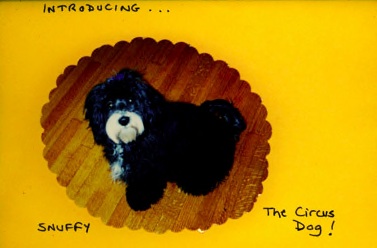
Snuffy, Spirit Guide aka Circus Dog

I've been crying a lot. Grieving my Snuffy, my little dog who had to be put down 18 months ago. He was twelve years old, but had been sick for five years with a chronic illness. Back in my twenties, I had a blind psychic friend who told me my spirit guide was a black dog. Somehow I imagined a big dog, like a labrador. A couple of days ago, it occurred to me it could have been a small black fluffy dog; my spirit guide could have been Snuffy. Made me cry. I have not cried for him until now, not once, always managing to say with great common sense, "Well, he was in such a bad way. It would have been one thing if he'd been run over, if he'd been young... but you wouldn't have wanted him to live a minute longer than he did, the way he was." Which are - come to think of it - exactly the same words I have used about my father, wasting away with cancer. I haven't cried for him either, once past the day he died.

Everything is related. Everything repeats, until we get it.

I don't think there is a darn thing I can do about any of it except remain open, inquire into everything and be honest with myself. And start saying no, or at least, "Can I get back to you on that?" That would be a start.

I have faith that it is ultimately good: I created a 'Beyond a Vision Board' just a few short weeks ago in my writing class; it's like a collage filled with images and words that appeal to you right where you are, not aiming at some future time. Mine is filled with images of mothers and children, prayer hands and water, and the words 'Open to Change with Heart' and 'You are You. Whole.'

Whoever that is.

My 'Beyond a Vision Board'
P.S. Writing all this out feels like an enormous weight has dropped away. I thought, if Lois rescinds her invitation, it won't matter, because I have learned so much that I would not have learned otherwise. Instead, today a long phone call followed a flurry of emails and together we booked my flights, made plans, became giddy with excitement. Pure joy and gratitude. No hidden worm.


Saturday, September 24, 2011

Three Days on Retreat at Yokoji Zen Center

The Path - actually the road to the retreat center.
Well, a few more little detours on the path to digging into the early years. I guess I'm not looking forward to going there. Although I don't think the detours are detours at all. They are the Path itself. Of course, your life is your path. Meaning, as my extraordinary niece learned after spending ten days in the Amazon on retreat with a shaman (now there's a story!), that your specific life is your path: everything that happens to you, every person you meet, has something to teach you. That's an exciting thought, isn't it?  So it's important to look at the so-called interruptions and see how they figure in the scheme of things. I had three big ones in the past couple of weeks. My daughter flew down from Berkeley to spend her birthday week with us; my cousin from Australia unexpectedly arrived for three days on Friday; I drove Helen back up to Berkeley the following Tuesday, and came back to Long Beach the next day (long drive!); and Thursday was the beginning of our three day silent meditation retreat at a remote Zen center a fair drive away from home.

Helen as tiny snow angel
Any time I spend with my daughter is a happy time. She turned 22, and chose to come home to spend her first birthday with us in four years (since college). She strengthens me, gives me courage in myself, simply by her presence. That she wants to spend time with me makes me think perhaps I haven't been too shabby a mother. This is not a question that secretly begs reassurance: I believe your mother essentially stops being your mother at whatever age you are when you leave home. I had my mother until I was eleven; after that, I feel I brought myself up, muddling through with the help of my peers at boarding school. My mother was simply not there. So once Helen passed eleven, I was flying blind. Add to that strange American rituals like sleep-overs, proms, high-school electives, driver's ed, parent-teacher conferences, FAFSA, dating - all of which I had either managed on my own or never experienced. I was at a loss as to how to shepherd my daughter through many of these alien rites of passage. That she managed, we managed, is more testament to her than me, with a huge nod of thanks to her Dad, my husband, who is American and grew up in a large family with the kind of Mom I would love to have had. So all this to explain that whenever Helen rolls back into our lives, she brings a jolt of joy.

But something else. She also puts me back in the role of Mom. Remember Martha-Lou, the Voice Dialogue lady, advising me to find time every day to let myself cry? This is hard to do when you are being Mom. I don't care how old or mature your child is, it is surely disturbing to hear your mother say, "Excuse me, dear, I have to go cry now." So, I didn't.

Michele, my Australian cousin


Helen's arrival closely followed by my cousin's was surely no accident. This cousin is a middle child in a family of eight. Her father is my mother's brother, who was as terrifying to his children growing up as my mother was to my sister and me. My cousin took a different tack. Instead of becoming a people pleaser and an all round good girl, she rebelled. At 17, she decided she had had enough of being quiet and shy and set out to change herself. A little younger than I, she has become quite fearless, traveling the world by herself, independent and comfortable in her own skin. She is blunt and direct, fiercely proud of her wrinkles ("I earned every one of them and I don't want anyone telling me I look younger than my age. I am proud of my age and how far I've come!"), a sort of warrior woman, and just who I needed to come visit at a time when I'm feeling a little precarious. Her blood is in me, after all. But here's what she taught me. Sunday morning and I was torn between conflicting duties: my regular Sunday at Long Beach Meditation, checking in the beginners for the new series of meditation classes; and my cousin on a once in a lifetime trip to America; and Helen 's visit. I was agonizing over this until Michele said mildly, "Why not do what you want to do." Her words stopped me short. I have a choice? I can do what I want? An idea so rare it brought tears to my eyes. In the end, I checked in the beginners but chose not to stay, Helen went for a bike ride with her Dad, and Michele and I went whale watching, spending a splendid afternoon sighting hundreds of dolphins and many blue whales.
Yokoji, the Zen monastery that was our retreat center
By the time the retreat came around, I had been busy doing, driving, planning and coping for days. I was more than ready to set it all down and be quiet. I envisaged a peaceful time in this rustic setting: we were staying in a real Zen monastery, in the mountains below Idyllwild, about three hours away from Long Beach. The monastery, called Yokoji, was off the grid: electricity came from solar power and a small generator. No cell phone reception, no paved roads, shared accommodations and loos, a communal bathhouse, vegetarian fare and no dessert apart from fruit. Two resident golden labradors and one visiting very friendly pitbull. Bring your own sleeping bag and pillow and bath towel. I envisaged a rough, semi-camping experience, and was pleasantly surprised to find it far nicer than I'd anticipated. We spent so little time in our rooms that the bare bones of the sleeping arrangements was not a problem. And enough loos were dotted about the place that that wasn't a problem either. We spent our days either inside the zendo (the meditation hall), or walking outside, 30 or 45 minute sits alternating with 30 or 45 minute walking meditations. We had an hour's rest after lunch, an hour of yoga in the afternoon and in the evening, an hour's dharma talk given by Victor. The day began supposedly at 6 a.m., but I was usually awake earlier than that and in the hall by 5 or 5:30. The last sit was over at 10 p.m..

Victor walking down from his cabin, being greeted by one of the resident dogs.
Friday, after the first walking meditation, Victor challenged us to break our patterns. We sit like statues, he said, hardly daring to move, trying so hard to be "good little meditators". And then we go outside and pet the dogs, stare at the mountains, walk at our usual brisk clip. So the question is, can we take our meditation off the cushion? Can we break our patterns, so ingrained, so persistent? Victor suggested the only way he knew how to do it was to slow everything way down, walking especially.
The beautiful butterfly wing
So at the next walking meditation, I walked back and forth over the wooden bridge. Two boards' width was exactly one foot length. Ten precise steps with each foot covered the bridge. Back and forth I trod, carefully, mindfully, placing each foot within the planks of wood, not lifting the one foot until the other was stable, synchronizing breathing and walking. After plodding back and forth many times, I noticed something sticking up between the boards: half of a butterfly wing, a beautiful wing, unusual, multi-colored, pink and blue and black. It was perfect. And I would never have noticed it if I hadn't deliberately been walking so very slowly! Happily, I picked it up, examined it and wondered what to do with it. I carried it back to our zendo in cupped hands. We had an altar upon which people were encouraged to place treasures. I hadn't brought a treasure, but now I had one. Later when we were sitting, I had to smile. Picking up the butterfly wing and putting it on the altar was such typical Ali behavior. "Look what I found!!" Even without words, sitting in silence,  it is possible to shout that message. So much for breaking patterns. The atypical thing would have been to have left the wing alone for someone else to notice in wonder, when they were walking slowly and mindfully across the bridge. I considered taking the wing and stuffing it back where I had found it, but thought that would be silly. Still, the whole incident underscored how being aware of patterns - let alone breaking them - is a moment by moment affair.

A second, related theme of the weekend was, do we take refuge in awareness or in the personality? The whole thrust of our being is to take refuge in the personality, in the self. We say, "That's just the way I am. That's me!" Yet the self is impermanent, thoughts are fleeting, emotions too. Ajahn Sumedho, the wonderful American Buddhist monk whom we are studying on Wednesday nights says,
"The mood comes and goes. It changes, revolves; it's happy, sad, elated, depressed, inspired, bored, loving, hateful, and on and on like this. According to the conditions that come together at this point, then the mood is this way. It's so easy to say, "Oh, I'm in a bad mood" or "I'm in a good mood." Our language is like that, so we become the mood. "I feel happy today, everything's fine" or "Today is one of my bad days." That's why I encourage this investigation of thought, so that you're not creating yourself, endlessly reinforcing the sense of a self through your proliferating thoughts."
p. 230, The Sound of Silence 

Picnic tables on the right
I sat writing about this at a picnic table after lunch that first day, intoxicated by the scent of the pine trees all around, the sun warm on my back, the breeze gentle. It was perfect. Then I thought, imagine if it were cold, rainy, muddy... The monk who gave us our orientation talk told us that just the day before our arrival there had been a hail storm such as he had never seen in seven years of living on the mountain. Hail stones as big as golf balls. So imagine if it was like that. Would I be feeling so mellow? No. Taking refuge in the personality with its "proliferating thoughts" then is dangerous, just like Ajahn Sunedho said - we are "sensitive," dependent on too many factors, any one of which can change at any moment: weather, temperature, bodily aches and pains... (Ah, but when everything is good! Then "God's in His Heaven, all's right with the world"... and it's almost impossible to summon up energy to inquire within).

Victor sitting in front of the altars, big and little

Friday night's dharma talk was for me one of those electrifying talks that Victor conjures up at least once on retreat. Here is the quote around which he built his talk:

"The empty mind cannot be purchased at the altar of demand; it comes into being when thought is aware of its own activities - not the thinker being aware of his thought."
J. Krishnamurti, 
Only Revolution California Part 3

"When thought is aware of its own activities..." that would be us! WE are thought, the thinker IS thought. Not simply being aware of our thoughts, "Oh, that's just a thought!" But that which is thinking, "Oh, that's just a thought!" is itself a thought! The empty mind is the mind that realizes this. Hard to do, you're - er - thinking. Well, yes. From the standpoint of the ego, impossible. Because the ego is the part that thinks. Awareness - that which we truly are - does not think. It reflects. It mirrors back what is. But we have allowed the thinking mind to take over to such an extent, our sliver of pure awareness is almost lost. And this is why we must work so hard at something that is probably quite simple: being quiet and still in the mind. Being with what is, moment to moment, without reference to thought, to memories past, or expectations for the future. When you sit for any amount of time and try to stay in the present moment, you immediately see how difficult this is. As Victor has noted, the mind has a tremendous resistance to staying in the present. It has nothing to do. And if it has nothing to do, it catches a whiff of its own mortality and it panics. Who am I, without thought? Incessant thought, that critical voice in the head that endlessly comments and judges and compares and analyzes. Whatever else it is, it feed us the illusion that we are not alone. Stephen King, master of horror, said, "Alone. Yes, that's the key word, the most awful word in the English tongue. Murder doesn't hold a candle to it and hell is only a poor synonym."

The thinking mind is robotic, mechanical. You can argue that it's not, but the proof for me was when I was doing The Artist's Way, writing three pages every morning without fail for twelve weeks straight. In the ninth week we were instructed to go back and reread what we had written. And what a shocker to find that certain thoughts played out compulsively over and over again, each time written as if I'd never had that thought before. In fact I would have sworn it was brand new. Yet here was the proof. Pages and pages of repeats. The Voice Dialogue work shed a little light on that: maybe the thought seemed new because each time a new persona was thinking it, and since they have no interest in speaking to each other, don't want to know each other's thoughts, then perhaps for that one it is in fact a new thought. (I don't know if this is true. It's just a thought!)

So for me the galvanizing thing Friday night was when Victor told us this: "Imagine that you have just been given a spiritual book. One that you have searched for, longed to read for years, and at last, in this very beautiful library, the book is placed in your hands." He continued, "Wouldn't you read every word, every page, of that book with interest and curiosity? Now..." (drumroll) "...imagine that you are that rare book. You must learn to read yourself, your thoughts, your mind, with equal interest and curiosity."
"Know thyself"
After this dharma talk, I was wide awake, mind racing. If we hadn't been in Noble Silence, I would have been up all night discussing this. Isn't it funny how an idea can spark something? I felt like a keen college student, exposed for the first time to Big Ideas. I loved being that book in the library. Because it seemed to bring together all the strands we have been reading and talking about lately. And for me it also seemed to marry the psychological work to the spiritual, which is usually quite a conundrum: How to bolster the self on the one hand only to knock it down with the other?

So I was thinking, if awareness is a mirror, it is reflected through the self. Each of us has our own unique self through which to reflect back out into the world this awareness, which in fact we share with every living thing. Call it energy, if you like. You can have bright energy, high energy, low energy. Your job then is to polish your mirror, your self, so that what you reflect back into the world is bright and clear-seeing. So yes to therapy, to self-examination. Chogyam Trungpa spoke of spiritual bypassing - how much easier it would be, to just hurtle over the murky bits of the self and get straight to the calm sitting. But it doesn't work like that. The things you do not face simply go underground; they do not disappear. Maybe you will be able to tiptoe through life avoiding the thing that will trigger you - but since you are likely unaware there even is a trigger, how do you know what to avoid? Until the unfortunate day when that buried aspect of yourself comes roaring out, to everyone's surprise, but mostly your own.

All my life I have leaped over the sad bits of my life, like a super-hero leaping over tall buildings in a single bound, eager to get on with it, with life, with its seemingly continuous forward motion. I bought my family's unspoken motto, "Never look back, never go back." Now I am finding out that I must go back and revisit every dreary floor - I like the image of trudging up and down each skyscraper, in and out of all its rooms, down the corridors, the elevator shafts.

The funny thing is, after we have done the work, spent the effort reading every line of our one book, it seems we will find that the book wasn't the thing at all. After all, it is one book among billions, a single volume in that library containing a copy of every book ever written. So what? Is it the library, is that it? The container of all those individual stories? As the ocean is to the little wavelets on its surface, each wave unique yet part of the whole? So what's the point of reading our own story so carefully? Is it to discover the commonality of our stories? If I plumb my own depths, will it increase my compassion for others? There are only so many plots after all...

Talk about "proliferating thoughts."

I had an interview with Victor the following morning, still brimming with excitement over these ideas. We sat outside at a picnic table. I told him how much I loved the idea of reading the book in the library. Mildly, he pointed out the fatal flaw - "WHO is reading the book?" Aaaargh. He added, "Why does there have to be anyone reading the book? It is being read." So imagine that. There is nothing to do, nothing to be. It just is. Hard to fathom this! I love words, I love analyzing and yes, thinking. And analyzing and thinking provide a good cover for not doing the actual work. HH tells me the same thing. So often I will plunge into an intellectual discussion, while he keeps trying to bring me back to feeling, as in, "What are you feeling right now?" Most of the time, I haven't a clue or don't want to know. Who wants to be sad? I'd rather live in my head.

So here I am on retreat, thought firing on all cylinders, and Victor is warning me that the mind is very clever, it can find connections between anything. My clever mind is busy doing just that. I can spin a good story about investigating elevator shafts, but in fact I am back to my old trick of leaping over the tall buildings, aka messy emotions, flying high on pure thought.

Meanwhile, something else is going on. I noticed during the first full day, Friday, whenever I was feeling particularly upbeat and happy, for instance during the little story of the butterfly wing, there would follow a tearful interlude. Nothing dramatic, just a little drip of cold tears. They weren't even accompanied by great physical sensations, no tightening in the throat or heaviness in the chest, just a steady drip of tears. In the restroom below the zendo was a little card tacked to the wall - "In case of cold weather, please don't turn the tap off completely." I knew enough about cold climates to know the dangers of pipes bursting from frozen water expanding. I thought the stream of my cold tears was analogous to relieving pressure in the pipes. I thought to myself that this was the little girl from Voice Dialogue, the one who holds the sorrow, feeling safe enough to show her face and gently weep. It was all very calm and measured and actually rather pleasant.

Somehow I lost control. I wish I could tell you how it happened. And why. It would be nice to be so aware I could pinpoint the exact thought that set me off. But truth is, I can't say for certain what happened. By Saturday afternoon, the sorrow was growing, the tears less polite, the sensations in the body becoming unbearable, until I knew that sooner or later I was going to break down. I thought yoga wold help - it usually does - but when I found tears sliding into my ears while lying in savasana, I knew meltdown was impossible to avoid. The very next sit, the one right after yoga which is usually the best one as far as I'm concerned, the pipes burst. Luckily I remembered that at Goenka they would escort you outside not just for laughter (as I knew firsthand), but also for sobbing. In both cases, the sounds and emotions can infect others. So when I felt an unstoppable "ugly cry" arising, I got up from my seat and with a panicked glance at Victor and a vague wave at my face, fled the zendo.

My room, there's my bed right by the door.
I charged down the hill and into the room I shared with Wendy. I threw myself on my bed and sobbed as if my heart would break. The same thing had happened at last year's retreat, but in the morning. And it didn't last as long, nor was it as severe. And I managed to chatter to myself, before, during and after, about what was happening and what it might mean. This time around, there were no words or thoughts in my head. Just sobs, just like during the Voice Dialogue session. It helped a lot having that behind me. I wasn't panicked about a need to attach the tears to a particular story.  Goenka again said something useful about our stories - that the story is only necessary to lead us back to the emotion. Once you feel the emotion, you can let go of the story and simply stay in the body. So the thing here was to cry it out. I felt like a child who is overtired and cries for no reason - but still needs to cry. I did go on and on with the crying, and felt a little frightened. I wondered if I'd ever being able to stop. Then Wendy came to the room after the sit and in silence stood next to me, in silence rubbed my back like the good mother she is. After a long while I was able to whisper, "I'm ok." Thank God Wendy had been part of the Voice Dialogue workshop and had seen that sobbing child before. Plus she's a therapist and one of my strong supports. I frightened myself, but I didn't frighten her. It was a huge help. Eventually she left for supper and later I found out she asked the Yokoji people to put a plate of food aside for me. She whispered to me it was "up the stairs in the kitchen" but I didn't know where the kitchen was, and since I wasn't hungry, I didn't hunt for it. But I appreciated her kindness.

My favorite Buddha
After Wendy left and while the others were eating supper, I washed my face and escaped from the room. I took my notebook and pen and held them tightly, words ever my lifeline, although I didn't write. And I walked all over the property. There are Buddhas scattered about the place, stone ones with big ears, wooden ones, carved ones, big ones, even a funny little one wearing real clothes, an orange bathcap and robe. I found my favorite, a tall androgynous Buddha with fresh purple flowers around his/her head and a small child looking up beseechingly.

Big yellow comforting dog
I sat next to it and for the first time noticed a tall wooden pole next to me. It had five sides, each side with words painted upon it. The side facing me read, "Buddha Spirituality. Experience No Separation." Which so fit with what I had thought all those hours ago in the morning, about why we must study our own little books in order to better understand one another, that I copied it into my notebook. Then I felt self-conscious to be caught mooning about on a rock next to the Buddha, face all puffy with tears, so I walked about some more. The dining hall was empty by now so I made myself a cup of tea and took it out to the picnic table where one of the big dogs was stretched out.  I put my head down on her yellow fur and cried. I think many people have done this very thing because she knew just what to do. She turned her head and licked my face, lay back down and let me cry on her some more. When I was quiet, she got up and moved to the end of the table and I made my way back to the zendo.

Tran hugging me in the silence
Tran and some of the others were outside, looking up at the setting sun reflected on the mountain. Tran is my beautiful young friend who always makes me laugh. She hugged me with such strong arms I could carry on with the evening's program. (In an aside, Tran played a large part in last year's retreat. This year, when we were allowed to speak, I told her, "I think we've grown up a bit since last year." At least we weren't wildly inappropriate and there's a switch).

When I finally did get to bed, I could hardly sleep and next morning I was up and dressed in the dark and in the zendo by 5. Someone was doing yoga stretches at one end of the room and I wrote in my notebook at the other. I wrote about the night before, all those tears, that there was no reason. And that it's all thought, isn't it? Anything I write is a thought. A thought put into words. If it can be put into words, it's a creation. Was it that idea - that we are thoughts - that on some level is so bleak? But that thought is itself a thought. How the mind can occupy itself, going round and round in thought.

We are not vegetables if we don't think. I think that is the fear. (My fear. One of them.) There is much beyond thought, beyond the descriptive power of words.

 For instance, the words to the left, by Brian Andreas, read:
"I read once that the ancient Egyptians had fifty words for sand and  the Eskimos had a hundred words for snow. I wish I had a thousand words for love, but all that comes to mind is the way you move against me while you sleep and there are no words for that."

"There are no words for that." Yet we "know" just what he means. When I speak of the comfort in Wendy's hand rubbing my back, or Tran's strong embrace, you can imagine how it felt. Words are the signpost to something beyond thought. But we've invested thought with such importance that now we must go through contortions to turn ourselves off. I do realize the hand, the embrace, the sense of touch, are still creations, still "things" arising from the senses, from this conditioned realm. But we start where we are, and here is where I am. I imagine pure awareness is that empty stage and all the little selves quiet. Nobody wanting anything from anyone. And there. Silence. Of course in the imagining, I conjure up another creation...

Life is not linear after all, but a spiral. These reflections are not very different from last year's retreat reflections. Then I wrote after that crying jag:
"My little girl, felt in the tight heart of the night before, was the one who was shattered. After spending an entire, excruciating year clawing her way into the light, now she is dismissed, and told she is "only a thought?" Oh no! This was a plunge back into darkest pit."

Ajahn Sumedho again, "When the self starts to break up, some people find that it becomes very frightening, because everything you have regarded as solid and real starts falling apart." What's different is that each go round, it seems what I thought I understood, I only understood intellectually. It has to be experienced in the body. As Victor wrote a year ago, "There is no path that skirts your crying, Alison." I didn't understand that then. Perhaps I couldn't. Not sure I fully understand it now, it runs counter to years and years of programming and change is not easy. And now I have come full circle: this is where I began, trying to break the old patterns. The retreat showed just what a monumental task that is.

When we were no longer in Noble Silence on Sunday, I told Wendy I think we live our lives from the tip of the iceberg. And we haven't a clue what's going on below. Hardly an original thought but I understood it in my bones. Also that I felt as if I never needed to overeat again. That lasted until the next meal, but at the time it felt like I no longer needed a padding of fat to cushion life's edges. I did feel lighter, as if all those tears had shucked off a great swathe of old sorrow. How, why, to what purpose or for how long, who knows. My aunt, my mother's sister, says I am reclaiming my childhood, my self. We will see where it goes. If I say I have a destination, I am looking for a certain outcome, I am setting up expectations and am no longer open to what is. So we shall have to see.

And probably at our next retreat, I will spiral around once more to these same reflections and I will cry and be shocked and write about them as if they were brand new.  But hopefully I'll expose a little more of the iceberg. (What did I just say about setting expectations?!)

Victor read us more from Krishnamurti on Saturday night:
"The sky is very blue, the blue that comes after the rain, and these rains have come after many months of drought.  After the rain the skies are washed clean and the hills are rejoicing, and the earth is still.  And every leaf has the light of the sun on it, and the feeling of the earth is very close to you.  So meditate in the very secret recesses of your heart and mind, where you have never been before."


In my next blog, I will explore that sad little girl who lives in "the very secret recesses" of heart and mind and see what she has to say.

Saturday, October 23, 2010

Part 3: Silent Meditation Retreat: "The thinker is the thought."

These were the thoughts of Saturday morning after breakfast when I returned to my room and wrote in my journal. At the words, "Ineffably sad", I went in search of a cup of coffee. I have learned in my journaling to pay attention to the moments when I distract myself. I am an old hand at steering clear of the hard emotions. It was no coincidence that coffee seemed like a good idea at the point of "sad". Nor is it coincidence that it has taken me more than a week to see what I was avoiding: I have so studiously refrained from revisiting this day, I didn't even write about it in my original reflection.

But back to that Saturday. Fortified with coffee, I let myself go on a facile pseudo-spiritual riff, words now that make me wince:
"Today the sun is so warm on the back, the birdsong so piercing, the sky so blue - what more could one want? Put the little self to bed, set it aside gently, watch the body breathe, watch the tummy rise and fall, don't think, don't think! It's easy, a baby can do it, we complicate everything, thinking it must be something tricky. Houston Smith talks about climbing the mountain - and then, much later, you realize there never was a mountain to climb. You are it - we are it - all along, we are it. And we have forgotten. We think we are more than - and less than."

Nothing wrong with the words as such, except that they flow too easily. La la la. Victor has talked about the ego, how clever it is: it will be whatever it thinks you want, including "spiritual". So this stream of commands to myself is ego's attempt to be deep. The words have no substance to back them up; they skim the surface.

I picked up my writing again after lunch and it was more of the same. Blah blah blah. The next few hours were very long, the overriding sensation: my knees hurt and I had a hard time sitting comfortably. Things became interesting at Victor's dharma talk, which was on thought. Someone wrote him a note, asking, "Who is it who is saying, "Who am I?" Who's saying, "I am thinking this?"" This talk, he said, would be his best effort to answer, the most thorough he had ever given on the topic. He told us how in Temecula, three or four days into a week-long retreat, upon waking up early to unlock the doors to the meditation hall, the thought came to him, "Why bother? What's the point?" (The people at the retreat had been falling asleep the night before and he was fed up). He told us he could have slid into that hell - that hole - and had a horrible day. Instead, the thought came to him, or rather his awareness: "It's just a thought!" and like that it was gone! He quoted Krishnamurti, "The thinker is the thought" and this is the point that's hard to grasp: we think there's our mind and then there's us. In fact they're the same. And if thoughts are "just thoughts" then we're not too solid either. And it's not just bad thoughts. We're not the good ones either - at least, they are all "just thoughts". He answered the question I had emailed him earlier about how he handled the terrible news of his old friend: how did he not sink into sorrow right then and there? "Same thing," he said. "It's just a thought." He told us about the night before the extraction of two of his teeth, lying in bed worrying and then being able to stop himself by saying, "I refuse to allow this thought to dictate to me!" - something like that. Refusing to give it power. Why spend a sleepless night when you don't know what will happen? I found this to be an empowering idea. Why indeed?

During the last sit of the night, the French song, 'Sur le Pont d'Avignon' popped into my head for no reason. This was a favorite sing-along in my family, trotted out on long car rides, and immediately brought to mind my parents, my French mother, my English Dad, both dead now. I realized that it was a year ago, the Monday after last year's retreat, that my mother came to me in a dream and said she would meditate with me. And when I sat and imagined her sitting with me, I burst into unexpected tears, overwhelmed with the feeling of love. It was clear then how much she had loved me, and that all she had done, she had done out of love: misguided, but love nonetheless. So now, a year later, and so much has happened to me in terms of my understanding...

Well, of course I couldn't simply stay with this feeling, which made my heart ache; I had to shape it into thought, form it into my beloved words and so find distance. Sitting up in my little bed later that night, I once more carried myself away on a stream of no-nonsense twaddle. I thought of my mother and assured myself that yes, yes, she loved me, this is by now old news. "I truly understand", I wrote confidently. "And if Victor's contention is correct - "It's just a thought!" - well then, why hang on to these painful thoughts from so long ago? I understand that because of my abandonment issues, I tend to cling and do too much and actually bring about the very thing I fear. But I don't see how I can go on feeling abandoned now that I understand all parties were only doing their best. What parents would deliberately set out to hurt their child? I was loved, I was happy - and really, the suffering came from boarding school which was what was 'done' in those days. I refuse to allow this ancient history any more space in my current life!! Victor will say I am thinking my way out of it. Yet this weekend I have cried, but in general terms of 'sorrow' - not anything specific. So I don't feel wracked with pain as I have done before. It truly feels behind me and now I can move forward with understanding." 

Those last two sentences should have set off warning sirens. Even as I was writing myself this bossy pep talk, I was aware that the body was telling a completely different story. In parentheses, I even wrote, "Why is my chest feeling tight? Is there something I'm not acknowledging? Breathe into it. Anxiety? No, anxiety is lower in the tummy. This is the chest. Tight. Like tears. Who needs to cry? Is it my little girl? Oh poor darling. But now I must turn out the light - it's time to sleep. We'll see tomorrow."